Hydrodermabrasion and Aquafacial: what the names tell you
When looking for a facial, you will encounter several names. An offer's name alone says little about the device, solutions or additional steps used. The distinction helps you compare an offer with the procedure that was actually studied.
Compare the terms
What is hydrodermabrasion?
The term describes treatment of the skin's surface with the aid of liquid. In the HydraFacial system discussed here, superficial exfoliation, suction and solutions are combined. The study therefore describes a particular procedure and its components.[1]
A distinction from microdermabrasion helps put this in context: the broader term describes mechanical exfoliation at the skin's surface; the hydrodermabrasion studied combines liquid and suction. This difference alone does not establish which gives a better result.[1]
Method, offer name and studied system
| Term | What does it tell you? | What needs clarification? |
|---|---|---|
| Hydrodermabrasion | A description of a method used at the skin's surface. | Which system and components are actually used? |
| Aquafacial | The name used for an offer. | What does this particular offer include? The name alone is not enough to compare it with a study. |
| HydraFacial in the study | A named system and a combined programme.[1] | Does another offer match the combination that was studied? |
The table helps you interpret names. It does not establish that different devices are equivalent or that a studio has particular equipment.
Which components belong to the combination?
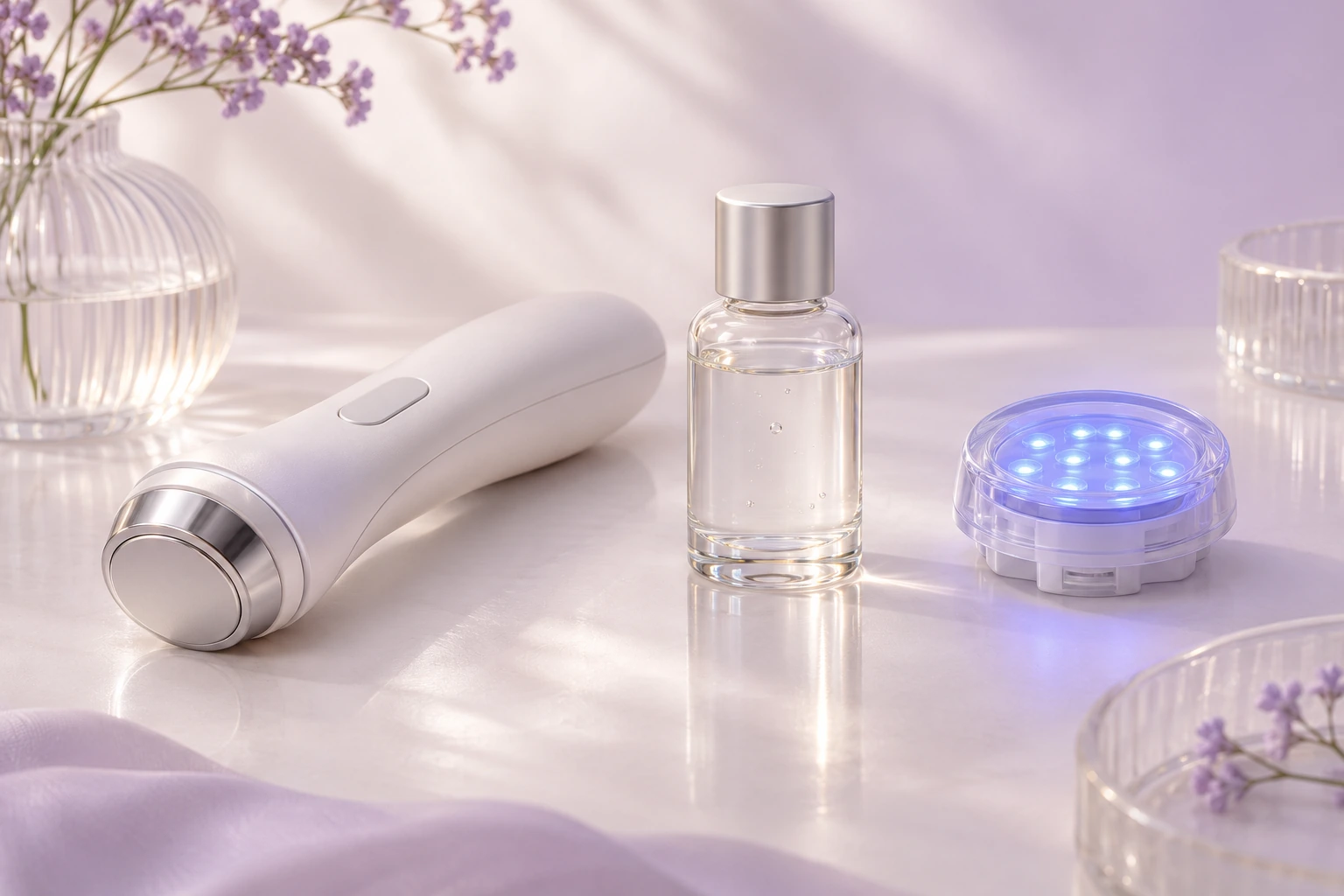
Device and procedure
Solutions used
Additional steps
For the research question, the device, solutions and additional steps belong to the described combination. The cited study included blue LED light. It cannot establish the contribution of hydrodermabrasion alone.[1]
What was actually studied?
A small, open-label study in adults with mild-to-moderate acne reported improvements after a combined HydraFacial programme. There was no comparison group; solutions and blue LED light were also included. The observation concerns this combination.[1]
The article describes a follow-up two weeks after the last treatment. This does not establish a lasting result. One author was employed by the manufacturer; the article reports no funding.[1]
How does this help you compare offers?
When an offer cites a study, ask whether it uses the same system and components. Research on a combination can answer questions about an individual component only to a limited extent.
The goal needs to match, too: an observation in acne does not automatically answer questions about wrinkles or long-term skin tightening. Check what was assessed and how long participants were followed. A photograph taken immediately after a facial would answer a different question from an assessment made later.
A small study cannot reliably rule out rare adverse effects. Positive observations and suitability for every skin type are different claims.[1]
Five questions to ask before a facial
Which system do you use?
Ask for its exact name. This lets you match a research reference to the actual offer.
Which solutions and additional steps are included?
Ask what belongs to the offer and what is offered separately. This includes asking whether light is used.
What cosmetic goal are we discussing?
Describe your concern specifically and ask how a change would be assessed. A general phrase such as "better skin" leaves a great deal unexplained.
How do you assess whether it suits my skin?
Discuss previous reactions to skincare products and your current routine. Ask how irritation would be handled.
Which claim does the cited study support?
Ask which group of people and which combination were studied. Discuss the limits of applying those observations to your concern.
Your first visit to Mary4Beauty
If you would like to discuss your wishes and suitable cosmetic care first, our Introductory Facial page explains what to expect at your first visit. Introductory Facial.
Introductory Facial
A first visit to discuss your wishes and choose cosmetic skincare together.
Explore your first visitSources & studies
Storgard R, Mauricio-Lee J, Mauricio T, Zaiac M, Karnik J. Efficacy and Tolerability of HydraFacial Clarifying Treatment Series in the Treatment of Active Acne Vulgaris
Clinical study, JCAD, 2022, pp. 42–46. Small, open-label study of a combination without a comparison group; includes solutions and blue LED light. One author's employment by the manufacturer is disclosed; the article reports no funding.
Return to the discussionAmerican Academy of Dermatology. American Academy of Dermatology issues updated guidelines for the management of acne
American Academy of Dermatology guideline summary, 2024. Context for medical acne management, without evidence for a particular cosmetic offer.
Return to the discussion