LED and photobiomodulation: which question do the studies answer?
An LED study reference becomes useful when you know which device was studied for which concern. Acne results answer a different question from observations about wrinkles. Check the device, population and measured outcome before applying a finding to your own concern.
Explore the two research questions
One light source, different research questions
LED describes a light source. Photobiomodulation is a term used for light-based applications under study; the term alone does not establish a particular outcome. The reviews discussed here concern home devices and different skin concerns.[1][2]
The general question "Does LED work?" is therefore too broad for a decision. Ask which device was studied, in whom, against what comparison and with which measurement. A change in acne lesion count is a different finding from an assessment of wrinkles.
Consider acne and facial aging separately
Acne
Did acne lesions or an investigator's overall assessment change?
A systematic review and meta-analysis by Ershadi and Barbieri reports positive results for studied home red and/or blue LED devices in mild-to-moderate acne. Outcomes included skin lesions and investigator assessments.[1]
Devices, comparison conditions and applications differed. The authors limit the transfer of results to other devices. The findings do not recommend every mask or its use for every form of acne.[1]
Signs of facial aging
Were wrinkles, skin texture or elasticity assessed, for example?
The systematic review by Das and colleagues describes positive findings for studied home LED devices, including wrinkles and skin texture. It brings together different study designs and measurements.[2]
Limited comparative data and underrepresentation of diverse skin characteristics restrict general conclusions. The review does not establish the same or a lasting effect from any other device.[2]
Read a study in four steps
This sequence is a reading guide. It does not show a biological chain of effects or rank devices.
Acne example
Device
Studied home device
Question studied
Mild-to-moderate acne
Outcome measured
Lesions or investigator's overall assessment
Check transferability
Do the device, population and comparison match my question?[1]
Facial-aging example
Device
Studied home device
Question studied
Signs of facial aging
Outcome measured
For example, wrinkles or skin texture
Check transferability
Was the same outcome measured, and does the device match the study context?[2]
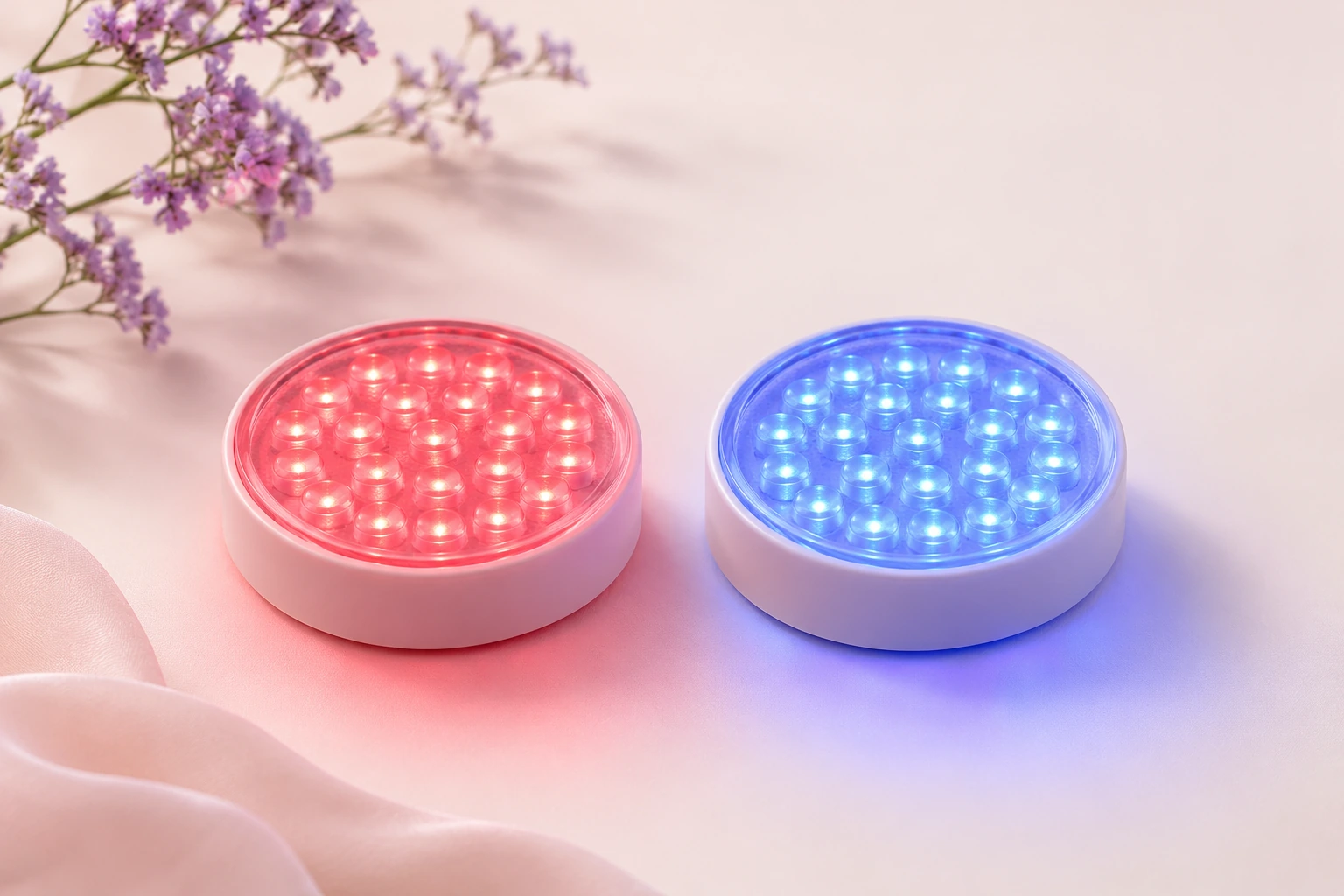
Home device and studio treatment: what can be transferred?
Both reviews concern home devices. They cannot establish superiority over studio treatments or the effect of a particular studio combination.[1][2]
If an offer includes skincare products or additional treatment steps, ask about that entire combination. A positive finding for one studied device does not automatically identify the contribution of each component.
A review and a guideline also have different roles. The AAD's 2024 summary describes insufficient evidence for recommendations on light- and laser-based acne procedures. This is neither a blanket LED ban nor an endorsement of a particular device; newer positive findings need to be read within their own scope.[3]
Questions before deciding
Which device and setting?
Ask for the exact device name and clarify whether the cited study concerns a home device or a studio treatment.
Which people and concern?
Check whether acne or signs of facial aging were studied. Ask how well the studied population matches your concern.
What was the comparison?
The comparison condition belongs to the result. Ask whether it involved, for example, a sham device, a different application or no treatment.
What was measured, and when?
Distinguish an investigator's assessment, an instrumental measurement and personal satisfaction. Ask about the observation period and what is known about how long a result lasts.
Which limits and possible reactions need discussion?
Ask what remains uncertain and how suitability, instructions for use and possible irritation are addressed.
Discuss your skincare at Mary4Beauty
If you would like to discuss your wishes and suitable cosmetic care first, our Introductory Facial page explains what to expect at your first visit. Introductory Facial.
Introductory Facial
A first visit to discuss your wishes and choose cosmetic skincare together.
Explore your first visitSources & studies
Ershadi S, Barbieri JS. At-Home LED Devices for the Treatment of Acne Vulgaris: A Systematic Review and Meta-Analysis
Systematic review and meta-analysis, JAMA Dermatology, 2025. Studied home LED devices for acne; device and study differences limit transferability. The review is not a separate re-verification of every original trial.
Return to the discussionDas RK et al. Efficacy and Safety of At-Home Light-Emitting Diode Photobiomodulation for Facial Rejuvenation: A Systematic Review
Systematic review, Aesthetic Plastic Surgery, 2026. Home devices and signs of facial aging; varied study designs, limited comparative data and representation of diverse skin characteristics. Does not establish superiority over studio treatments.
Return to the discussionAmerican Academy of Dermatology. American Academy of Dermatology issues updated guidelines for the management of acne
American Academy of Dermatology guideline summary, 2024. US context for medical acne management; no German legal assessment or recommendation of a cosmetic offer.
Return to the discussion