
“Clean Beauty” sounds gentle, safe and sustainable—and that is exactly what many people want when their skin is quick to react or they simply want to shop more mindfully. Then the packaging confronts you with big words such as “natural”, “free from” or “eco-friendly”. The problem is that these promises are often phrased so loosely that they are hard to pin down.
A quick check can help you assess claims in seconds: what is genuinely specific, what is more about creating an impression, and when is it worth taking a second look at the INCI list (ingredients)? If you want to explore the topic further, the blog has more background on ingredients and everyday skincare guidance.
30-second label check: vague words versus clear statements
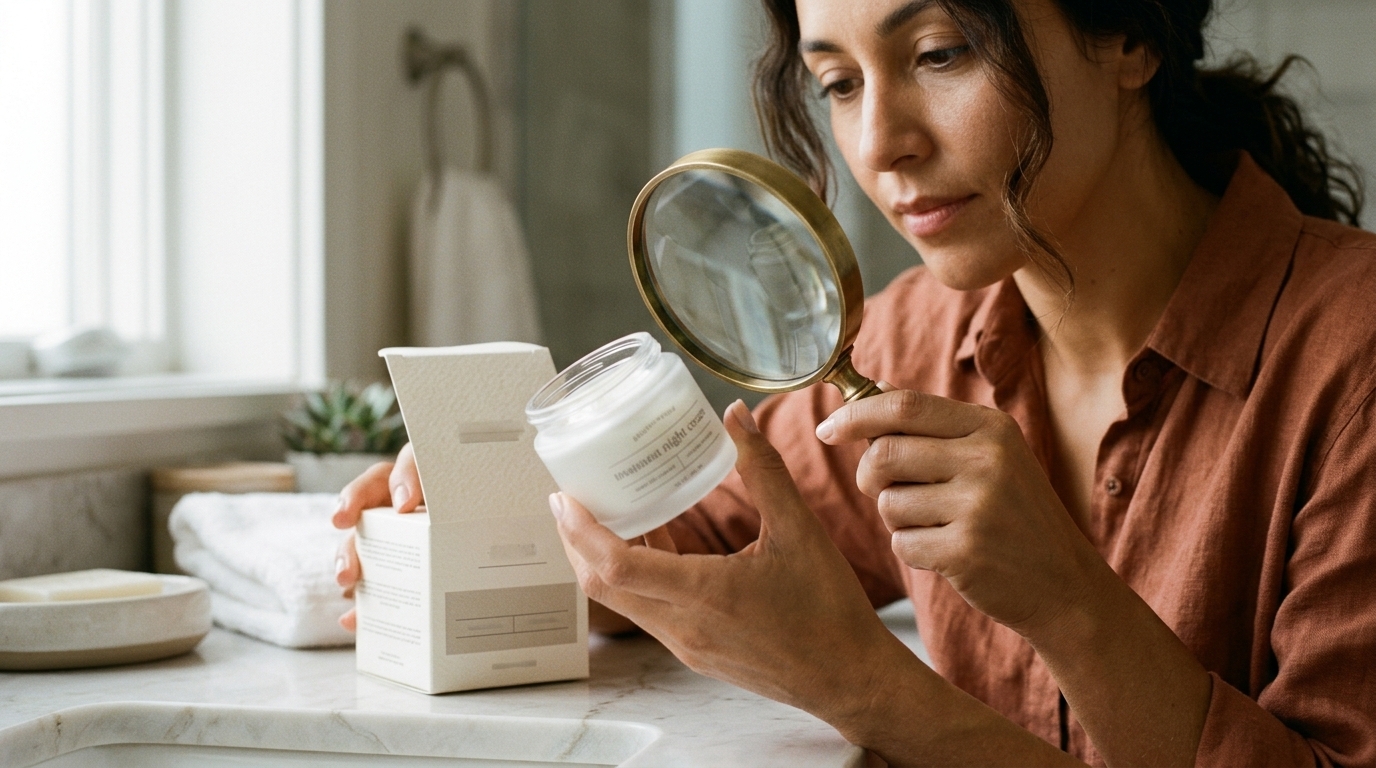
Many Clean Beauty claims feel reassuring at first—but offer more of an impression than real information. Since “Clean Beauty” is not protected by a clear, consistent definition, brands can mean very different things by it. So it is best to treat the label check as a quick filter: how much substance is actually behind the words?
Steps (quick and practical) 1) Identify the claim: Which statement is meant to persuade you? Result: you are checking not “the product” as a whole, but one specific claim. 2) Look for the point of reference: Is it about the formula, packaging or supply chain? Result: “eco-friendly” without a reference point remains vague. 3) Assess “free from” claims: What is left out—and is it explained why that matters? Result: you can more easily spot positioning instead of evidence. 4) Specific beats grand: Precise claims are often printed in smaller type, but are much easier to check (e.g. a clearly named subject or a comparison with the previous version). Result: less suggestion, more concrete information. 5) Quickly cross-check the INCI: The INCI list shows what is actually in the product, regardless of what the front says. Result: “hero” ingredients, Parfum/Fragrance and technical terms (e.g. PEG/“-eth”) stand out immediately.
Common pitfalls - Blanket terms such as “chemical-free” or “toxin-free”: they sound clear, but cannot be checked without a reference standard. - “Sustainable” without a defined scope: it is unclear whether this refers to material, quantity or something else entirely.
If you get stuck (troubleshooting) If a claim is very prominent but also rather vague, that is often a sign that a clear standard is missing. Then it is especially worth checking the INCI list and any seals.
Note: In the EU, cosmetic claims are expected to be truthful, fair and supported by evidence, among other requirements. For shoppers, that evidence is usually invisible—making clear, verifiable wording on the label all the more important.
The 3-point self-test: specific, checkable, substantiated
If you want to read Clean Beauty claims critically, a simple framework can help. These three questions separate “sounds good” from “is concrete”: specific, measurable, substantiated.
1) Specific: what exactly is it about? Clear is better than nice-sounding: “fragrance-free” is more concrete than “gentle”. Be cautious with lifestyle words such as “pure”, “green” or “conscious”—without a definition, they say little. “Natural” also remains open-ended without clear criteria.
2) Measurable: could it be checked—and how? Measurable does not automatically mean “numbers on the packaging”. A claim just needs to be tied to something that can be checked: a clear comparison (with what?), a defined test method or a stated period. Without a basis for comparison, phrases such as “more moisture” remain open to interpretation.
3) Substantiated: where does the claim come from? Relevant substantiation could include a test report, a transparent study, a certification with documented criteria or a life-cycle assessment (LCA) for sustainability claims. “Can be substantiated” is more than a nice extra. If this topic comes up in everyday life, it may also help to read why transparency matters so much in Clean Beauty.
Mini examples - Vague: “eco-friendly packaging” → it is unclear what exactly is better. - More precise: “bottle made from recycled plastic” → clearer, but still limited without context. - Vague: “with valuable rose oil” → without more information, its relevance remains unclear.
Quick quiz (2 questions) 1) Does the claim have a clear point of reference (formula/packaging/…)? 2) Can you imagine how it could be checked—yes or no?
FAQ (briefly) Is “clean” a protected term? No, the criteria vary from one brand to another. Are seals automatically a free pass? More of an indication; transparent criteria are what matter. Why is the INCI list so important? It lists the ingredients according to a set system, regardless of the marketing. Is “free from” always better? Not automatically—the reason and context matter. What is a typical greenwashing move? Big words without a standard, comparison or evidence.
The framework works like a translator: either advertising language becomes verifiable, or you can immediately see that it lacks substance.
Clean Beauty is not an automatic promise of quality; often it is just a choice of words to begin with. Checking claims quickly for specificity, verifiability and evidence makes it less likely that you will be swayed by “green” feel-good language. The INCI list offers a level-headed counterpoint to the front-of-pack label.
In practice: pick one or two products in your bathroom and run them through the 3-point test. Open questions (“How is this measured?”) quickly show whether a claim holds up.
It is a good idea to save the 90-second check for your next shopping trip. If you are unsure about a claim, you can get in touch through mary4.beauty—the site has information about the studio, contact options and the option to request an appointment or book directly.