
Which acne scars tend to be considered for microneedling—and why improvement is often moderate
Acne scars can remain visible for many years after the original breakouts and make the skin’s texture look uneven. Against this background, Microneedling is often seen as a way to smooth uneven areas and make the skin look more uniform. Studies and clinical reviews do report noticeable improvements, while also stressing that results vary considerably from person to person. It helps, then, to have a realistic sense before a consultation of what counts as “moderate” change and how to set expectations.
Which types of acne scars are typically considered for microneedling
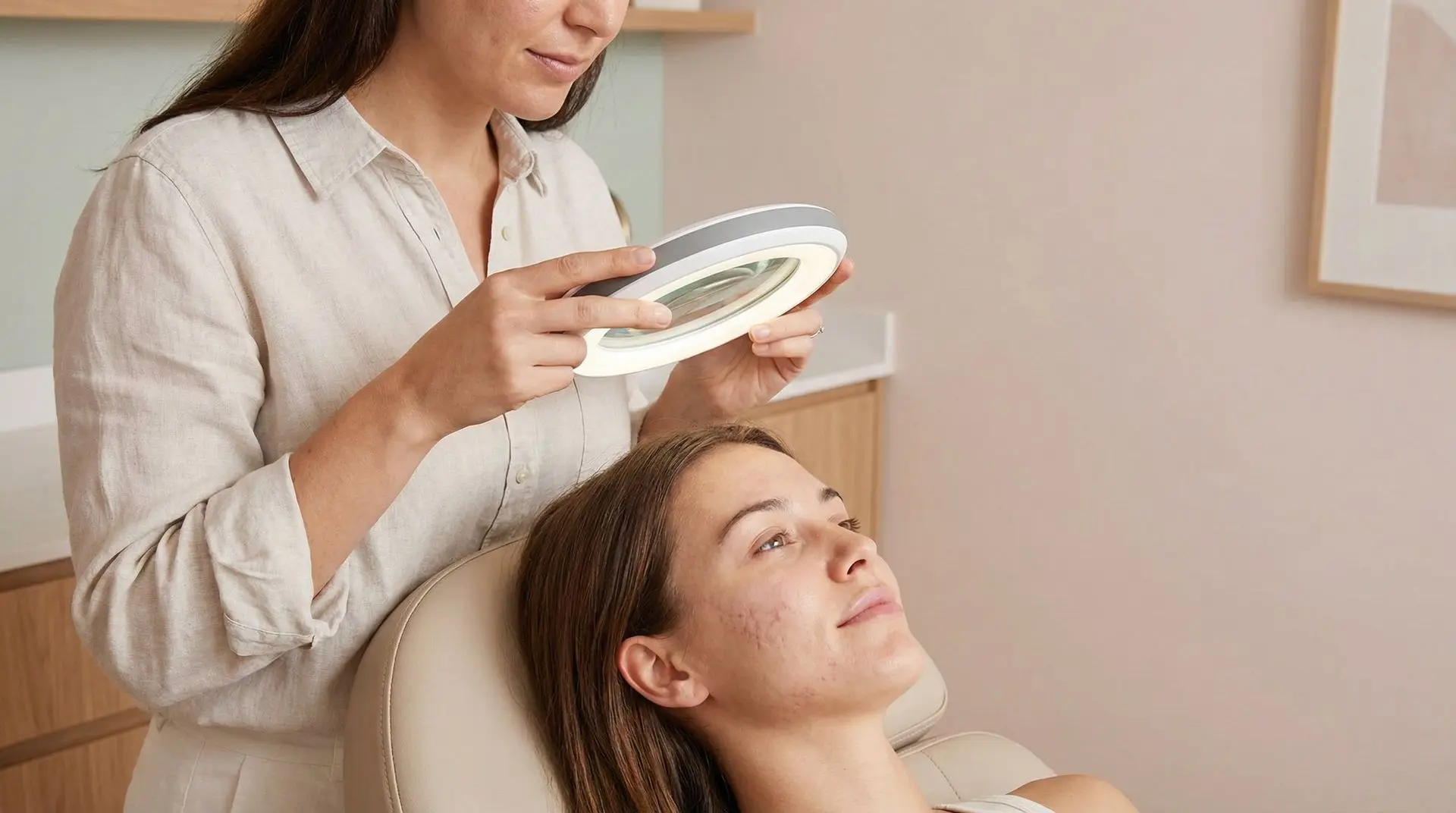
When Microneedling is discussed for acne scars, the focus is less on the treatment itself than on the texture of the skin. “Acne scars” covers several very different scar types, and their structure is a major factor in how well they may respond to Microneedling.
Microneedling is most often used for atrophic scars—depressions where the skin appears visibly pulled inward. Medical sources describe three subtypes:
- Icepick scars—very narrow and deep
- Boxcar scars—wider, clearly defined depressions
- Rolling scars—softer, wave-like unevenness
They form in different ways, but share two features: loss of tissue volume and disruption of the collagen structure.
These atrophic scars are the focus of studies on percutaneous collagen induction. Over a course of Microneedling, some depressions may look less sharply defined: their edges appear smoother and the transition to surrounding skin less abrupt. This is described most clearly for rolling scars and moderately pronounced boxcar depressions, where new collagen structures may partly even out the differences in height.
With icepick scars, the picture is more complicated. Given their shape and depth, the skin rarely becomes truly smooth, even after several treatments. Positive effects tend to mean softer edges or reduced visibility; reputable sources do not describe complete “disappearance”.
A separate group is made up of hypertrophic and keloid scars, which rise above the skin’s surface. They are mentioned very cautiously in connection with Microneedling, as other methods are usually considered first. Classic collagen induction is mainly intended to increase density in the dermis, which is not the desired goal for raised scars. That is why discussions of Microneedling focus almost exclusively on atrophic acne scars.
Many scientific reviews also stress that the degree of improvement can vary widely even when the scar type is the same. Factors include:
- Age of the scars
- Their depth and severity
- Individual skin thickness
- Previous skincare and accompanying treatments
For this reason, acne scars are described as “potentially reducible”, not fully correctable. Expectations are deliberately kept moderate.
How skin texture may change—and what not to expect
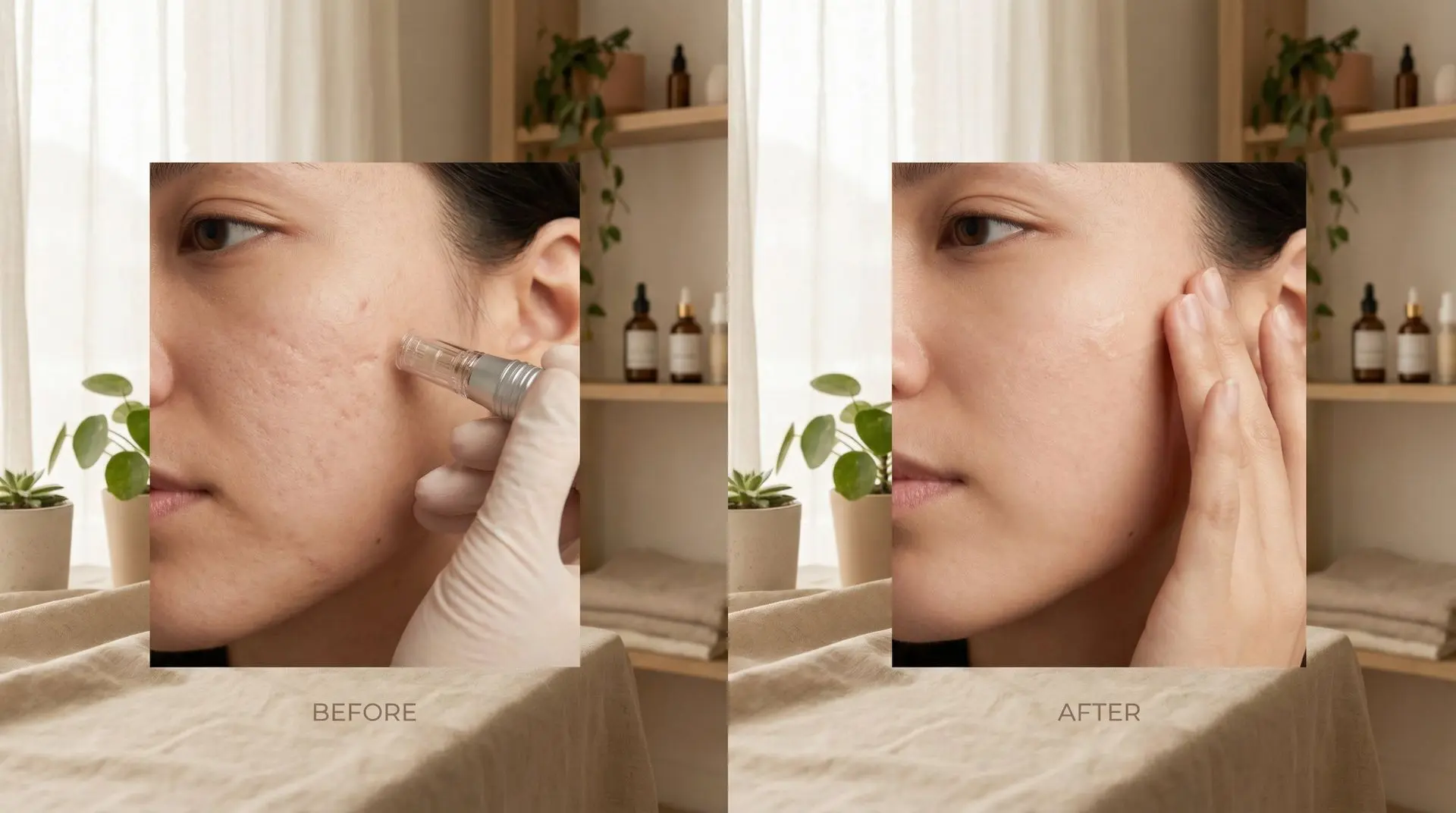
When people talk about Microneedling, their expectations often focus on the skin’s texture. But Microneedling is not described as a method that “erases” every uneven area. It is intended to soften contrasts and smooth transitions.
Acne scars include depressions, dense areas and zones with different tissue thickness. The micro-injuries set collagen production in motion: new fibres may partly “fill in” the transitions between scarred areas and healthy skin, changing how light reflects and making shadows look less harsh.
This is most visible with shallower, softer unevenness. In these areas, people may notice:
- smoother transitions
- a more even-looking profile
- less “waviness” when running a finger over the skin
With deep, sharply edged depressions, the effect is more limited: the edges may soften and the scars may draw less attention, but they remain visible.
Results can also be uneven. Some areas respond very well, while others hardly change. A before-and-after comparison therefore reflects many small improvements—which helps explain why people often say after a course, “Overall, my skin looks more even,” rather than “All my scars have disappeared.”
What Microneedling cannot do:
- completely remove deep acne scars
- turn the skin into a perfectly smooth surface
- produce immediate results after one session
- make pores invisible (pores are natural structures)
Care is also needed with pigmentation changes: Microneedling primarily affects texture, not differences in colour. Hyperpigmentation left after acne is also influenced by skincare, UV exposure and genetic tendency. Experts therefore often recommend combined approaches. Whether Microneedling with an acid peel suits your skin should be discussed individually in advance.
The realistic overall picture is this: Microneedling may reduce visible contrast, soften depressions and make the skin look more even—but it cannot completely “reshape” old scars.
Conclusion
Microneedling is one of the methods that may gradually improve uneven texture caused by atrophic acne scars. Medical sources more often report reduced depth, smoother transitions and a more harmonious overall surface—not the complete removal of deep structures.
Before starting a course, it is worth discussing with a qualified practitioner:
- which type of scar is present
- which combinations of methods might make sense
- how many sessions are realistic
- when changes may become visible
- which signs call for another check-up
Having well-informed expectations helps put results in perspective and see the treatment for what it is: a potential way to achieve a more even, calmer skin texture, not an entirely new skin.