The skin barrier: structure, hydration and water loss
The skin barrier helps retain water and protect against outside influences. Cells in the outermost layer, lipids between them and water-binding substances work together. The water present in that layer and the water moving out of it are different properties. Understanding this distinction makes claims about hydration and barrier care easier to assess. [1][2][3]
Understand the terms
Listen to the key points
Read the short version
The skin barrier helps retain water and protect against outside influences. In the outermost layer, cells, lipids between them and water-binding substances work together. Water content and water loss describe different properties: one is an amount present, the other an outward flow. A skin value therefore needs its measurement method and conditions. A general explanation of the barrier does not establish the effect of a particular skincare product. Persistent concerns or inflamed or oozing skin need medical assessment.
What the skin barrier does
The skin barrier is a protective function in which the stratum corneum, the outermost layer, is particularly important. It sits at the outside of the epidermis, above the deeper dermis and subcutaneous tissue. The term does not refer to an additional film lying separately on top of the skin. [1][2]
This outer structure helps protect the body from harmful contact and limits water loss. It accounts for part of the skin’s work, rather than every function it performs. Sensing touch and regulating temperature, for example, involve other aspects of the skin. This article focuses on the outer structure and its relationship with water. [1][2]
A barrier does not mean that no water moves out at all. A slow outward flow through the skin also occurs physiologically. Limiting that loss and creating a completely watertight seal are different ideas. [3]
How the outer layer holds water
The outer cells are called corneocytes. Their function depends on how the parts work together: the cells need to remain connected, lipids lie between them, and water-binding substances help hold water inside the cells. Lipids are the fats involved in this part of the skin’s structure. [2][3]
Location helps explain the different jobs. Binding water within a cell is different from the role of lipids between neighbouring cells, which help limit evaporation. An explanation based only on “more hydration” therefore leaves out part of the structure. Lipids alone do not describe the entire barrier function either. [2]
Different jobs within the outer skin layer
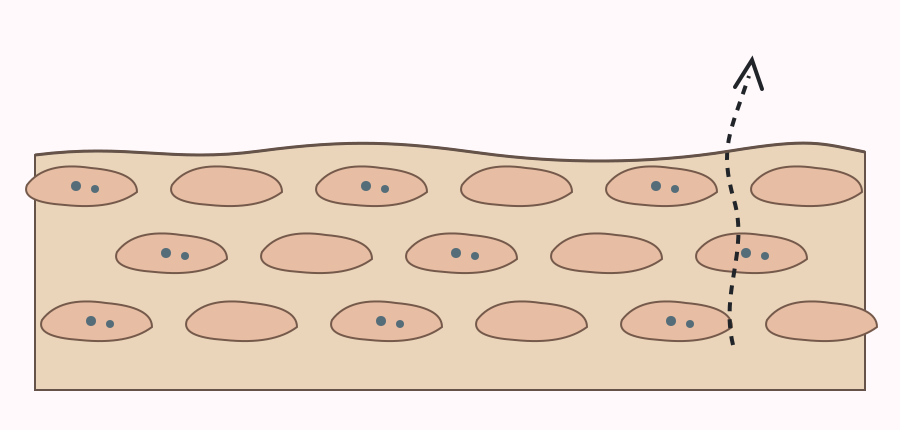
Corneocytes
Neighbouring cells form the outer cell layer. [2]
Lipids between cells
Lipids in the spaces help limit water loss. [2]
Water binding within cells
Water-binding factors help retain water inside the corneocytes. [2]
Outward water flow
Water can reach the surface; the barrier does not stop the flow completely. [3]
The simplified model shows relationships, not a measured tissue sample. It explains why several parts are considered together. It cannot show whether your own barrier is impaired or identify a suitable product or treatment for you.
Why the outer layer continually renews itself
The stratum corneum is continually renewed. New cells form in deeper parts of the epidermis. They move outwards, become keratinised and die. At the surface, the corneocytes form the outer cell layer. These terms therefore describe different stages in the cells’ life and their position within the skin. [1]
Tiny flakes of horn cells gradually leave the surface. New cells arriving from below replace what is lost outside. The protective layer is therefore not a coating formed once and left unchanged: cell formation and shedding are part of its normal renewal. This general process does not establish a personal recovery time after a particular exposure. [1]
Hydration and water loss answer different questions
Water content describes how much water is present in the stratum corneum. Transepidermal water loss, or TEWL, describes a flow: water moves through the skin towards the surface and outwards. An amount held and an outward movement are different properties, even though both involve water. [3]
This matters when interpreting a skin measurement or a claim that skin is “better hydrated”. A water-content measurement does not automatically answer how much water is moving out. A TEWL reading, in turn, is not a direct statement of how much water is stored in the outer cells. [3]
On a small screen, scroll the table sideways to see all columns.
| Term | Which question does it describe? | What does it not establish? |
|---|---|---|
| Water content | How much water is present in the stratum corneum? | Not a direct measurement of outward water flow. |
| TEWL | How much water moves through the skin towards its surface? | Not a direct statement of stored water or a complete diagnosis. |
A comparison of concepts without a shared numerical scale. Measurement conditions remain important to interpretation. [3]
The conditions of a TEWL measurement also matter. Temperature, humidity, air movement and the measurement system can affect interpretation. A value without its method and conditions is therefore difficult to compare meaningfully. The review used here examines device reliability and measurement error; it does not establish that a particular cosmetic treatment restores the barrier. [3]
What can put demands on skin in everyday life
Cold, wind, low humidity and dry heated air are described as external influences that can contribute to dry skin. The surroundings can therefore change even when a skincare product stays the same. Everyday context is a useful part of discussing a change in how the skin feels. [2]
Contact during cleansing, work or hobbies can also put demands on skin. The official health information names long, hot showers, very frequent baths and contact with alkaline soaps or cleaning agents among the possible factors. Repeated wet or irritating contact can matter too. Similar skin sensations cannot be assigned to a particular cause in an individual from this overview. [2]
Understanding claims about barrier care
Barrier care may refer to different aims: binding water, supplementing lipids or limiting water loss. These terms describe different functions. An ingredient fitting a mechanism does not by itself prove the effect of a particular finished product. The sources used here do not compare individual products used in the studio’s skincare.
A useful question is what the specific claim refers to. Is it about an ingredient, measured water content, water loss, or simply how a product feels? Keeping these levels separate helps make sense of the explanation without turning a term into a promised treatment outcome.
Questions for a skincare conversation
You do not need to understand measurement devices to discuss cosmetic care. A clear question and an understanding of what an explanation can cover are enough to begin. These questions prepare a conversation; they do not assess your skin or determine treatment suitability.
Which skincare and sensitivities would I like to discuss?
Your usual care, wishes and experience of sensitivities provide a concrete starting point. These are discussed together during Mary4Beauty’s Introductory Facial.
What was actually measured when a skin value is mentioned?
Ask which property and conditions the value describes. Water content and outward flow answer different questions. This does not mean that the studio offers TEWL measurements. [3]
What is the proposed care intended to achieve?
Ask about the cosmetic aim and the basis for that expectation. A general reference to the skin barrier does not replace support for a specific claim.
How this helps you discuss skincare
A barrier-care statement becomes easier to understand when its purpose is clear: binding water in the stratum corneum, considering lipids between the cells or assessing water loss. The outer cells also renew themselves, while skin meets different influences in everyday life.
For a specific skincare statement, it is useful to ask what it describes and what supports it. A pleasant skin feeling, a measurement and a demonstrated product effect answer different questions. This distinction helps you discuss a recommendation more precisely and understand its reasoning.
Further reading
Understanding hydrodermabrasion and Aquafacial
How a method, a cosmetic offer and a studied treatment combination differ.
Discuss your skincare in person
During the Introductory Facial, we discuss your wishes, usual care and possible sensitivities. We choose the specific cosmetic care together.
Explore the Introductory FacialSources & studies
Institut für Qualität und Wirtschaftlichkeit im Gesundheitswesen (IQWiG) (2025)
Official health information on skin structure and functions; not a cosmetic treatment trial.
gesund.bund.de (2025)
Official health information on normal skin function, external influences and medical assessment. Updated 17 September 2025.
Klotz T, Ibrahim A, Maddern G, Caplash Y, Wagstaff M (2022)
Devices measuring transepidermal water loss: A systematic review of measurement properties
Systematic review of TEWL device reliability and measurement error. Used for the definition and measurement context, not treatment efficacy.