Understanding hydrodermabrasion and Aquafacial
Hydrodermabrasion describes a treatment at the skin surface. Aquafacial appears as the name of a service, while HydraFacial in the study discussed here refers to a specific system. Similar names can cover different devices, solutions and additional steps. Understanding those components makes it easier to compare offers and separate supported expectations from questions a study did not examine.
Understand the terms
Listen to the key points
Read the short version
Hydrodermabrasion, Aquafacial and HydraFacial describe different levels: a method, an offer and a named system. Ask which device, solutions and additional steps are actually used. A small study reported improvements in acne after a combined HydraFacial programme that included blue LED light. Without a comparison group, it cannot establish the contribution of hydrodermabrasion alone. For your decision, check whether a study examined the same combination and your particular concern. Persistent or inflammatory acne is a reason to seek dermatological assessment.
What happens during hydrodermabrasion?
Hydrodermabrasion combines liquid, superficial exfoliation and suction. Exfoliation means loosening material at the skin surface. The HydraFacial application described in the paper also uses specific topical solutions; the study concerns that particular system. The presence of liquid alone says nothing about how deeply an ingredient enters the skin. [1]
A distinction from microdermabrasion helps explain the term: that method also involves mechanical treatment of the surface. The actual technique and products depend on the system, however. Similar word endings establish neither identical procedures nor the same results. [1]
If an offer is simply headed “Aquafacial”, its components still need explaining. A clear description names the device, the products applied and the included steps. This gives you something concrete to compare beyond a familiar name.
Three names answer different questions
These terms describe different levels. A method name explains a principle; a service name brings an offer together; a study examines a defined application. Keeping those levels separate makes comparisons clearer.
On a small screen, scroll the table sideways to see all columns.
| Name | Which level does it describe? | What does the name tell you? | What still needs checking? |
|---|---|---|---|
| Hydrodermabrasion | Method principle | Liquid, superficial treatment and suction are combined. | The actual device, products and included steps. |
| Aquafacial | Name used in an offer | The name brings an offered facial service together. | What does this specific offer include? Which method and additions are used? |
| HydraFacial in the JCAD study | Named system and studied program | The paper describes a particular combination including topical solutions and blue LED light. | Does another offer match that combination and the skin concern studied? |
The table explains terminology. It does not certify equivalence between devices or offers, or the equipment used by our studio. Source for the studied program: [1]
The final column shows what the name leaves open. Two similarly named offers may use different solutions or additional steps. Conversely, differently named services may share components. Matching an offer to a study requires a description of the actual combination.
Why the device, solutions and light need separate consideration
The components of a combined offer have different roles. Surface treatment describes the mechanical part. Topical solutions have their own composition. Light is an additional technical component; its inclusion cannot be inferred from the word hydrodermabrasion. Blue LED light was part of the studied program. [1]
Components of a combined offer
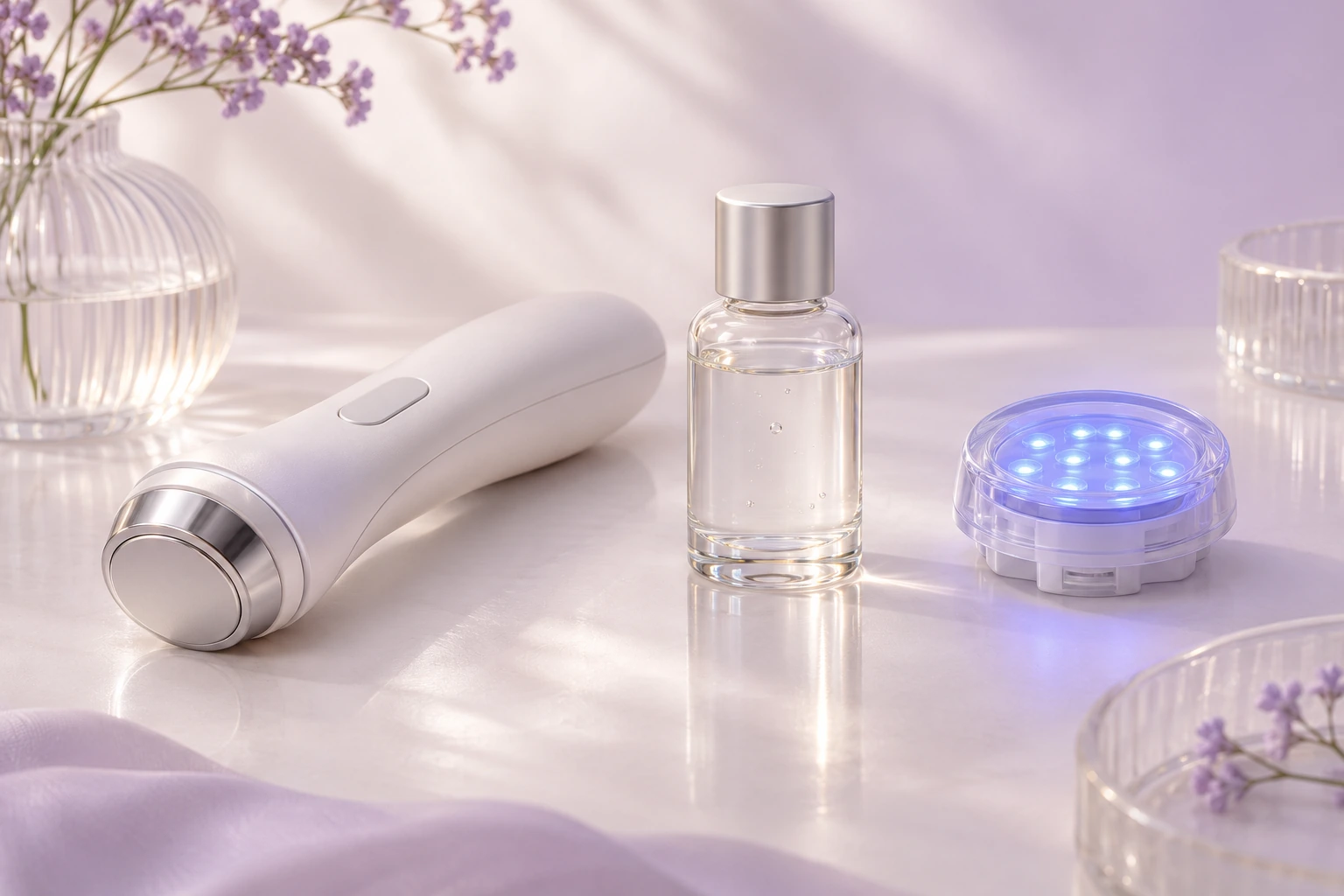
- Device and application
- Topical solutions
- Additional steps
The studied program combined the system, solutions and blue LED light. The study does not determine the contribution of each component. [1]
The illustration places components next to each other. It does not show a universal sequence or a particular device. What matters is the combination actually used. When all components are applied together in a study, an observed change cannot automatically be attributed to one of them.
The separate article on LED and photobiomodulation explains how light colour differs from the concern studied. Adding LED does not make different facial treatments the same application.
Which skin concern is being assessed?
Wanting a cleansed skin surface is a different question from treating acne. How skin feels immediately after a visit, its appearance in a photograph and a later assessment of a skin condition also describe different things. Before comparing treatments, it helps to name the concern more precisely.
A study in mild-to-moderate acne does not simultaneously answer questions about wrinkles or lasting skin firming. Those would involve different concerns and outcomes. The paper discussed here concerns adults with acne and a combined HydraFacial program. [1]
Persistent or inflammatory acne is a reason to seek dermatological assessment. The AAD guideline summary describes medical approaches to acne; it does not recommend a particular cosmetic offer. Cosmetic care goals and medical treatment should remain distinct in the conversation. [2]
If you would first like to discuss your cosmetic-care wishes, our introductory facial page explains a first visit to Mary4Beauty. This is a separate service entry, not a recommendation of the system used in the study.
What the available study shows
The 2022 JCAD publication by Storgard and colleagues describes a small open-label study without a control group. It enrolled 20 adults with mild-to-moderate acne. The assessed program combined the named system, topical solutions and blue LED light. The authors reported improvements in the acne severity assessed. [1]
Open-label means that participants and investigators knew what was being applied. Without a control group, it is difficult to separate the program’s contribution from other influences. It is even less possible to identify the contribution of an individual component.
Eighteen participants completed all six applications; eight of them returned for follow-up two weeks later. This short and incomplete follow-up limits what can be said about how long a result lasts. One co-author worked for the manufacturer; the article reports no funding. These details belong in the interpretation of the source. [1]
Observed change and expectations for your own visit
A positive study finding concerns the people and application studied. Before applying it to another offer, establish whether the device, solutions, additional steps and skin concern are comparable. The more those differ, the less can be transferred directly from the paper.
The assessment also matters. A questionnaire about appearance or how skin feels gives a different perspective from an assessment using a defined scale. Both can be useful, but they answer different questions. A convincing photograph does not replace information about the starting condition, photography conditions and assessment time.
This paper cannot establish a general success rate for all Aquafacial offers or a fixed duration of effect. A more useful discussion identifies the cosmetic concern and how any change would be assessed. [1]
What can be said about tolerability?
The study assessed redness, swelling, dryness and sensations such as stinging or tingling. The authors described the program as generally well tolerated, yet reactions were recorded, including one episode of severe tingling. In this context, “well tolerated” does not mean that every participant experienced no reaction. [1]
A small study cannot reliably rule out uncommon unwanted effects. Nor does it establish suitability for every skin situation or every other product combination. Known reactions to skin-care products and current products therefore belong in a discussion of the specific offer. This information is not a self-diagnosis checklist or a personal treatment plan.
Five questions that make an offer clearer
Which exact system is used?
The name helps connect a device description or study reference to the actual offer. A familiar service name alone does not supply that information.
Which products and additional steps are included?
Ask about the topical solutions and whether, for example, light is included. This compares the actual scope of the service rather than just its heading.
Which specific concern are we discussing?
“Better skin” leaves the intended change open. Clarify whether the concern is how skin feels, its surface appearance or a change requiring a different assessment.
How are my previous skin reactions considered?
Mention known reactions and current skin care. Ask how suitability is assessed and whom you can contact if a reaction occurs.
What does the cited evidence actually support?
A useful study reference identifies who was studied, which components were used together and the follow-up period. A promotional claim should stay within those limits.
Further questions about studies and offers
Can I turn the study description into my own program?
A study description records the application examined. It is not a personal recommendation for frequency, products or a combination at home. Those decisions depend on the actual application and individual situation; the cited paper does not test a general home program. [1]
Why does this page not name the “best” Aquafacial device?
The paper does not compare different devices or brands. It therefore cannot support a ranking. The useful comparison here starts with a complete description of an offer and evidence that fits it.
How to use these distinctions when choosing care
Start a comparison with the actual contents of an offer: which method is described, which products are included and which additional steps are planned? You can then consider whether a cited study examines the same combination and the same skin concern. A familiar name becomes a description you can understand, without turning it into a personal prediction of results.
If you are interested in cosmetic care at Mary4Beauty, you can read our Aquafacial offer. It describes the studio service and should be distinguished from the HydraFacial program studied in the paper. If you are still deciding what to ask about, the Introductory Facial offers a separate starting point: discuss your wishes, assess your skin and choose care together. The choice then starts with your concern and the actual offer rather than a general promise.
Further reading
Two different ways to explore the subject: LED fundamentals and a studio blog article about starting device-based cosmetic care. The blog is not clinical evidence.
Separate light colours, devices and the concerns studied.
A studio article about the conversation before more intensive cosmetic applications.
Mary4Beauty / Your first visit
Explore the studio offer
Read the description of our Aquafacial treatment, or start with a first visit if you would like to choose suitable cosmetic care together. The studio offer does not establish use of the system studied in the paper.
Aquafacial
Information about vacuum-based cleansing and accompanying care in the described studio offer.
Explore AquafacialIntroductory facial
A conversation, skin assessment and care chosen together during your first visit.
Explore the first visitChoosing cosmetic care does not replace necessary dermatological assessment.
Sources & studies
Storgard R et al. (2022)
Primary JCAD2022 paper; selected complete Methods, Results and limitations sections checked through PMC. Small open-label combination study without a control group; short incomplete follow-up; one author’s manufacturer employment disclosed.
American Academy of Dermatology (2024)
American Academy of Dermatology issues updated guidelines for the management of acne
AAD2024 guideline summary on medical acne treatment. US professional context; not evidence for Aquafacial and not an assessment of German law.