Understanding LED light for skin
LED masks and light treatments are associated with many different skin concerns. Understanding their potential takes more than a colour name: the type of light, the particular device and the skin change being studied belong together. Acne studies measure different outcomes from studies of fine lines. This guide explains how LED relates to photobiomodulation, which distinctions matter and what research can tell us about realistic expectations. [1][2]
Understand the terms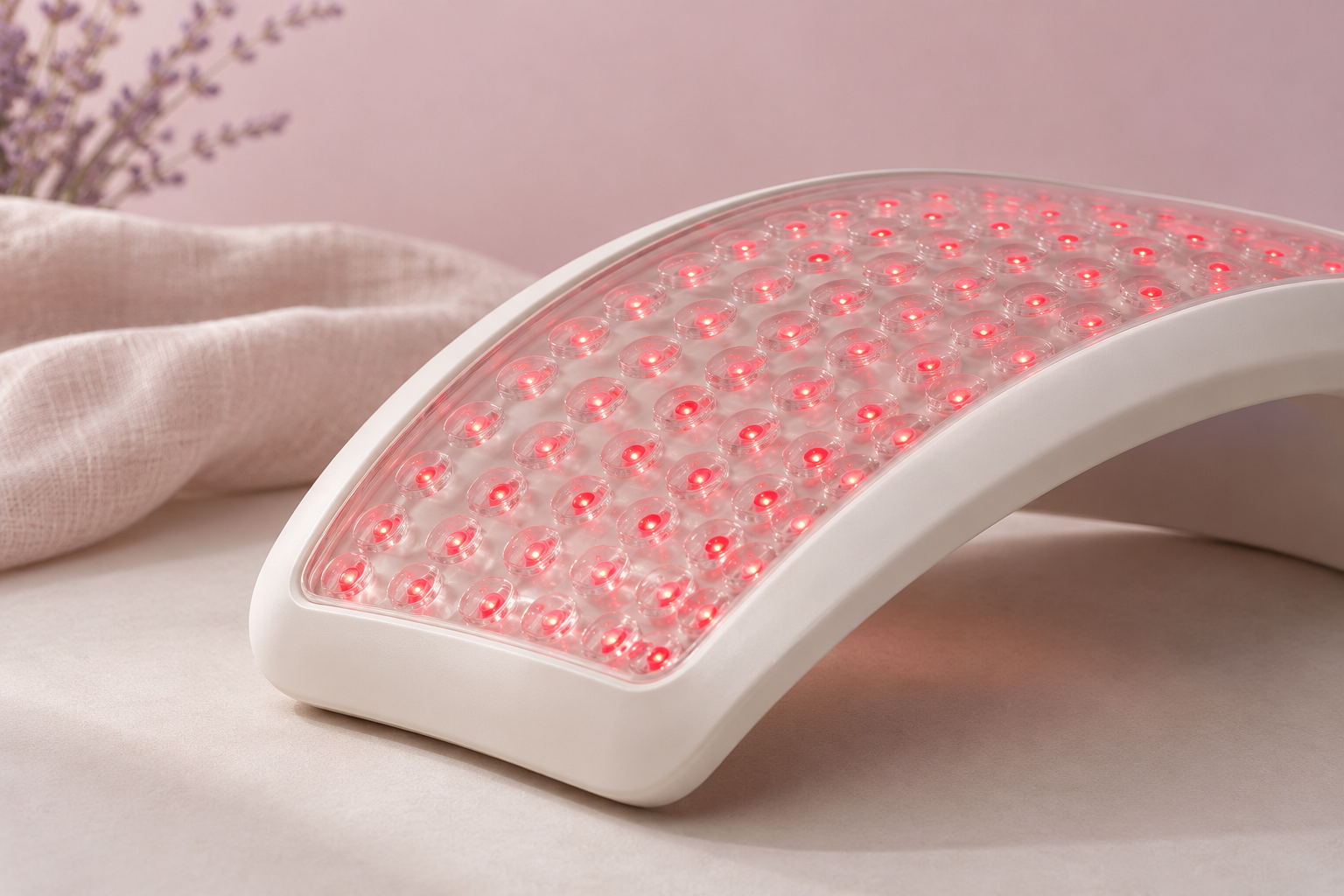
Listen to the key points
Read the short version
LED is a light source. What a study tells you depends on the device, the concern studied and the outcome measured. Reviews of home devices report positive observations in acne and signs of facial aging. These are different questions with different measurements. They do not promise an effect from every other device or a studio treatment. Ask who was studied, what the comparison was and how long participants were followed. Possible irritation also belongs in the discussion. Persistent or inflammatory acne is a reason to seek dermatological assessment.
LED, photobiomodulation and other light procedures
LED stands for light-emitting diode. The term describes the component that produces light. The name alone does not tell you what a device is intended for or which effect on skin has been demonstrated. An LED mask is therefore neither an ingredient category nor one uniform treatment. Systems used in studies differ, for example, in their wavelengths and the amount of light energy delivered. [1][2]
Photobiomodulation, or PBM, describes using light to influence biological processes. A dermatology review explains this approach for red and near-infrared light. Molecules already present in the body absorb light, which can alter cellular signals. The term describes an approach to producing a response; whether that leads to a visible improvement is a separate clinical question. [5]
Why the terms are not interchangeable
A device can be described by its light source and by the purpose of its use. LED answers the first question; photobiomodulation answers the second. Blue LED light is also studied in dermatology, but an explanation should not simply treat it as equivalent to red or near-infrared PBM. [1][5]
Laser and IPL also need their own explanation. Our laser and IPL comparison separates those terms. Sharing the word “light” is not enough to transfer research findings from one procedure to another.
Blue, red and near-infrared: what differs?
Wavelength describes a physical property of light. Within the visible spectrum, we perceive different wavelengths as different colours. Near-infrared light lies beyond this visible range. A value in nanometres, or nm, therefore describes light more precisely than a programme called “Glow” or “Anti-Aging”. The dermatology PBM review treats red and near-infrared as different spectral regions. [5]
Research on home LED devices for acne includes blue light, red light and combinations. In research on facial ageing, red and near-infrared light were used particularly often. This helps explain why programmes mention different goals. It does not establish a rule that a particular colour resolves a particular skin concern. [1][2]
Where selected wavelengths lie
Four examples from the reviews discussed here. Position shows wavelength; further right does not mean more effective.
Wavelength in nanometres (nm)
Chart values and sources
| Light example | Wavelength | Source location |
|---|---|---|
| Blue | 414 nm | Acne review: Table, Gold et al.2011 [1] |
| Red | 633 nm | Facial-ageing review: Results, Mineroff et al. [2] |
| Near-infrared | 830 nm | Facial-ageing review: Results, Mineroff et al. [2] |
| Near-infrared | 1072 nm | Facial-ageing review: Results, Mineroff et al. [2] |
The chart places selected wavelengths on one common scale. The next step when assessing an offer is to ask which change is intended and whether appropriate research exists for the system being used. An additional colour programme does not mean an additional demonstrated benefit. A long colour menu does not, on its own, make a device more versatile in a clinical sense.
LED and UV: light source and wavelength
LED and UV answer different questions. LED names the component that generates light. UV means ultraviolet radiation, a particular part of optical radiation. Germany’s Federal Environment Ministry distinguishes ultraviolet, visible and infrared radiation. The name of a light source is therefore different from the spectrum it emits. [8]
The red and near-infrared applications discussed here should be distinguished from UV applications. The AAD describes red or near-infrared light in the context of photobiomodulation. A shared term such as “light treatment” does not establish a comparison with a UV application. Nor can a finding for one procedure simply be transferred to a different light category. [6][8]
For an individual device, the actual technical description still matters. A red glow in a photograph or an LED label does not replace information about what the system emits.
A statement such as “UV-free” would answer only that particular question. It would not establish effectiveness or individual suitability. The AAD also describes possible reactions and individual considerations for red light. What matters is the specific application and its device information, rather than a general label such as “gentle light”. [6]
How light can produce a biological response
Light must first be absorbed by an appropriate molecule to trigger a photobiological response there. For red and near-infrared PBM, the literature describes light-absorbing components in mitochondria among the relevant targets. Mitochondria are structures inside cells that participate in supplying energy. Changes in energy-related and signalling processes are studied as a possible link between light absorption and a cellular response. [5]
It helps to separate three levels: a device emits light; tissue absorbs some of that light; a clinical study checks whether a particular skin feature changes. Evidence at one level does not settle the next question. A plausible cellular mechanism can explain why researchers study a method, without showing how much a particular wrinkle will change.
From a light source to a question about skin outcomes
LED light source
Light reaches the skin · Skin surface
The device emits light. Skin can absorb part of it. Whether a particular skin feature changes is assessed separately in clinical studies. [5]
Why “more” is not a sufficient quality measure
The application being studied includes the energy delivered and treatment duration as well as the type of light. The PBM review explicitly identifies such parameters as relevant. [5] The number of diodes alone therefore cannot establish an outcome. A mask that looks brighter is not automatically more effective either: visible brightness and clinically measured benefit are different properties.
Consumers do not need to calculate settings themselves. The useful question is whether the technical information is understandable and whether the cited study actually relates to the application being described.
What acne research actually studies
The selected LED studies assess specific changes in acne, such as counts of inflammatory and non-inflammatory lesions. Here, “lesions” means the acne changes being counted. An investigator may also assess overall severity. This asks a much more precise question than a general claim to “improve skin quality”. [1]
A 2025 systematic review and meta-analysis combined six randomised studies involving 216 participants with mild to moderate acne. They studied portable or home-use systems emitting blue, red or combined light. The analysis reported benefits compared with the respective control conditions. Devices, comparison groups and observation periods varied. [1]
What matters for your own question
A reduction in inflammatory lesions and a change in acne scars are different outcomes. Someone mainly concerned about scars or lingering marks needs research addressing that particular goal. A heading saying “LED for acne” does not answer that follow-on question. Findings in mild to moderate acne should not automatically be read as findings about severe cases either.
In its 2024 guideline announcement, the US American Academy of Dermatology stated that evidence was insufficient to develop recommendations for several procedures, including light-based devices. [3] This is different from saying that light has no effect. Individual positive studies and a guideline recommendation serve different purposes; a later review does not automatically constitute an updated guideline.
What researchers measure in fine lines and skin texture
“Anti-ageing” combines several concerns that cannot be captured by one measurement. One study may assess wrinkles, another elasticity, skin surface texture or participant satisfaction. A softer feeling and a measured change in a wrinkle are therefore different outcomes. [2]
A 2026 systematic review examined eight studies involving 365 participants using home LED devices for facial skin. It reports improvements in several studied features, including wrinkles and texture; red and near-infrared wavelengths were used particularly often. This does not mean every outcome improved in every study. The authors identify varied protocols, limited comparative data and insufficient representation of diverse skin phenotypes. [2]
Separate visible change, satisfaction and duration
Three questions help interpret a finding: what was measured, what was the comparison and when was it assessed? Greater participant satisfaction is a relevant observation, but it does not yet give the size of an objectively measured wrinkle change. A finding at the end of a study also does not, by itself, tell us how long it lasts after use stops.
For realistic expectations, a specific description is more useful than “rejuvenates skin”. Look for an understandable statement about a particular feature within the setting studied. One effect score combining acne, elasticity and wrinkles would obscure these distinctions.
On a small screen, scroll the table sideways to see all columns.
| Criterion | Acne review, 2025 | Facial-ageing review, 2026 |
|---|---|---|
| Scope | 6 randomised studies, 216 participants | 8 studies, 365 participants |
| Situation studied | Mild to moderate acne; portable or home devices | Signs of facial ageing; home devices only |
| Light in the studies | Blue, red or combined | Red and near-infrared particularly common |
| Outcomes | Acne lesion counts; investigator severity assessment | Including wrinkles, texture, elasticity and satisfaction |
| Reported findings | Benefits against the respective control conditions | Improvements in several studied features, not every outcome in every study |
| Transfer limits | No blanket finding for scars, severe acne or every current mask | No blanket finding for every device, permanent results or studio combinations |
Sample size is not a comparison of effectiveness. Outcomes addressing different questions do not share one effect scale. [1][2]
Home device, clinical setting or beauty studio: what can be compared?
A device's shape reveals only part of its properties. Masks, panels and small handheld applicators can all use LEDs as their light source. The facial-ageing review specifically excluded in-office devices. Its findings therefore do not automatically describe a cosmetic treatment in a beauty studio. [2]
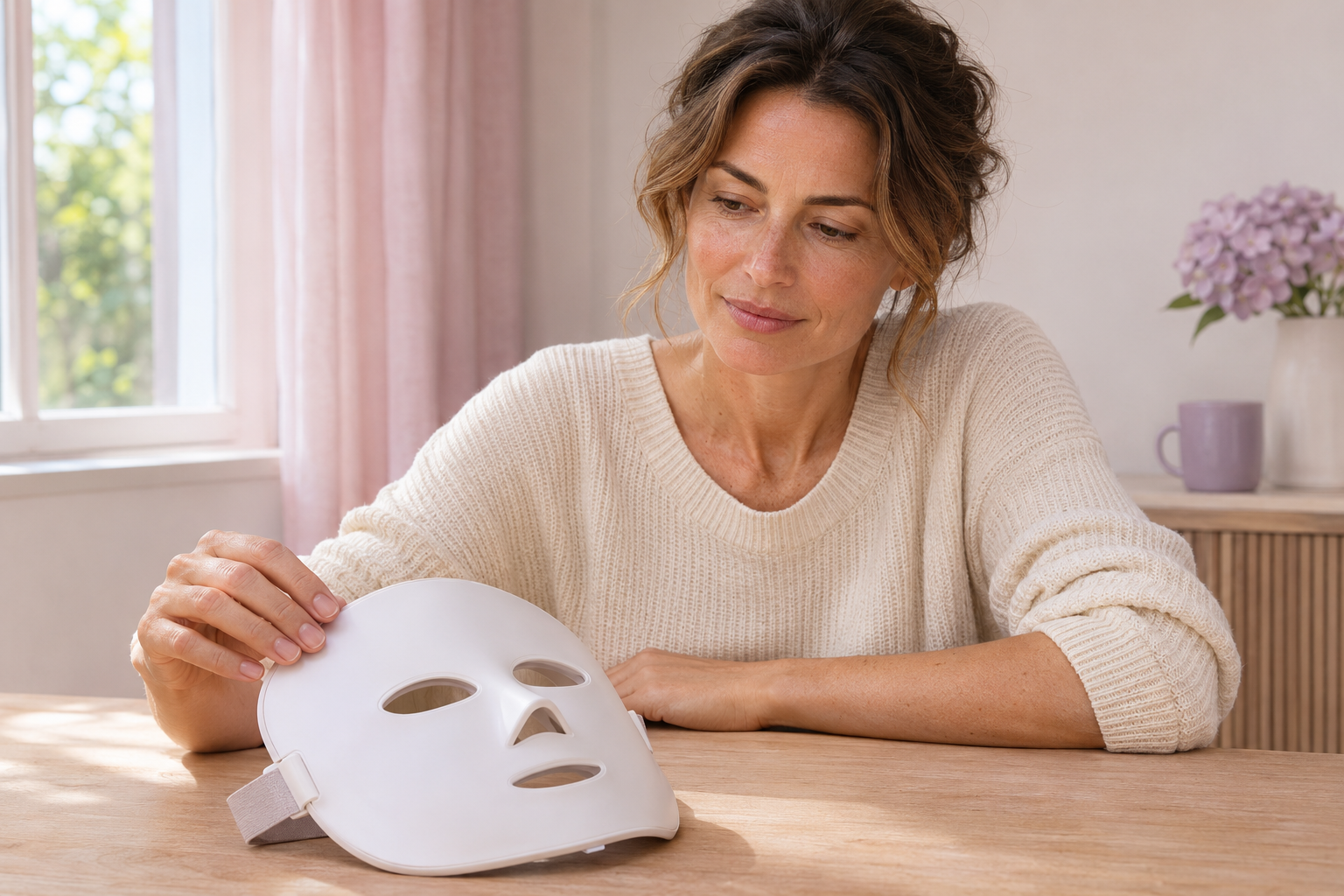
A meaningful comparison uses the same criteria: what light is used, which concern is being addressed, which application was actually studied and what information is missing? The expandable guide below explains which details help assess a description, without ranking any particular model.
Understanding device information
The light profile
- Light type and wavelength
The light used in the application
Does the cited study match this light and combination?
- Energy and duration
Parameters of the application studied
Diode count does not replace these details; do not derive personal settings.
The device and its goal
- Model and format
The particular system being described
A similar appearance does not establish technical or clinical equivalence.
- Goal and participants
The change and skin situation studied
Mild acne, scars and wrinkles are different questions.
The study context
- Comparison condition
What the outcome was compared with
Sham use, no use and another treatment are different comparisons.
- Other components
Whether use was isolated or combined
With several procedures, attribution of observed benefit matters.
- Assessment time
When an outcome was measured
Separate observation time from persistence after use stops.
Interpretation criteria, not a rating of a particular device or operating settings. The sources address different systems. [1][2][5]
A named model with understandable research is more informative than a photograph of a similar-looking device. Equally, the word “professional” does not establish superiority. A defensible comparison would require relevant outcomes under comparable conditions.
Combinations need separate consideration too. If LED is used alongside cleansing, skin care or another procedure, an improvement cannot automatically be attributed to the light alone. Our article on hydrodermabrasion and Aquafacial discusses the distinction between device names and treatment components.
Our own Aquafacial offer is an example of how combined cosmetic care is described. LED is listed as one component. Describing a combination is different from establishing an effect of the light alone.
What makes an expectation realistic?
A claim that can be assessed names its goal precisely. “Fewer inflammatory acne lesions” asks a different question from “smoother-looking skin”. Making that distinction helps before choosing a device: is the concern a disease, a particular visible feature or a pleasant skin-care experience? These goals can coexist, but they need different support.
The selected reviews describe use over studied periods and assess particular outcomes. They do not create a guarantee after one session or a reliable timetable for every other application. [1][2] In its red-light information, the AAD notes that results may take time and that not everyone sees them. [6]
Before-and-after photographs leave additional questions: are the lighting, photography conditions and other measures comparable? A picture can show change, but cannot on its own establish its cause or transferability. A precise account of what was observed and what it was compared with is more useful than a dramatic promise.
Tolerability is part of the assessment
LED light acts on skin from outside the body. That does not make potential reactions irrelevant. The selected reviews report some mild, temporary adverse effects; those observations do not guarantee safety for other devices or every skin situation. [1][2]
For red-light devices, the AAD identifies light-sensitive conditions and medicines that increase light sensitivity as matters to discuss with a doctor. It also recommends a dermatology discussion for darker skin tones because of possible pigmentation changes. Eye protection depends on the particular device instructions; sunglasses are not a general substitute for the specified protection. [6]
A colour diagram or online comparison cannot answer these questions personally. For acne, a conversation with a dermatologist can help assess the skin changes and suitable options. [4] This guide explains terms and distinctions; it does not replace that individual assessment.
Three questions that make an offer clearer
Understanding the light and the research makes treatment descriptions easier to assess. Rather than a very long checklist, three questions help obtain specific answers.
Which device and which goal are being described?
A model name and a clearly defined skin change make a claim assessable. Colour or a programme name alone are not enough.
Which study matches this claim?
The application studied, comparison group and measured outcome matter. A general LED study does not support every claim about a different system.
How are tolerability and other treatments considered?
Device instructions, relevant conditions and medicines belong in an appropriate professional assessment. For a combination, it should remain clear which benefit is attributed to which component.
Common questions about LED light
Is photobiomodulation the same as photodynamic therapy?
No. Photodynamic therapy, or PDT, uses a photosensitising substance followed by light treatment. The AAD describes it as a separate medical procedure. Its findings should therefore not simply be transferred to ordinary LED use without that substance. [7]
Can LED replace a skin-care or treatment routine?
The AAD describes red light as, among other uses, an adjunct within dermatological treatment plans. This does not establish a general replacement for other measures. What role light might have in a particular situation is a separate question from explaining the technology. [6]
Does a laser study also support an LED mask?
Not simply because both use light. The facial-ageing review distinguishes LEDs and lasers by their light emission and excluded laser-based systems. A mask needs relevant research for its system and application. The shared label “light therapy” does not establish that connection. [2]
A useful way to assess an offer is to name the skin concern first, understand the light source and specific system next, and then consider the relevant research. This keeps a cosmetic wish, a supported observation and individual tolerability distinct.
At Mary4Beauty
Cosmetic care at Mary4Beauty
Explore our combined Aquafacial offer or find out about a first visit.
Aquafacial
The service page lists LED as one part of the combination and describes the cosmetic care offered.
Explore AquafacialYour first visit
Discuss your wishes, usual care and possible sensitivities before choosing the specific care together.
Explore the Introductory FacialOur own cosmetic offers; listing LED as a component does not establish an effect of the combination or an individual device.
Sources & studies
Ershadi S, Barbieri JS (2025)
At-Home LED Devices for the Treatment of Acne Vulgaris: A Systematic Review and Meta-Analysis.
Review of home devices for acne; devices and studies differ.
Das RK et al. (2026)
Review of home devices for facial skin aging; no comparison with studio treatments.
American Academy of Dermatology (2024)
Updated guidelines for the management of acne.
Official US guideline summary; not a legal basis for Germany.
American Academy of Dermatology
Treating acne? Is it time to see a dermatologist?.
Patient information on dermatological assessment for acne; not evidence of LED efficacy.
Maghfour J et al. (2024)
Photobiomodulation CME part I: Overview and mechanism of action.
Terminology and mechanism review; the abstract was assessed here, not the full article.
American Academy of Dermatology
Is red light therapy right for your skin?.
Patient information on red light, adjunct use and precautions; US context.
American Academy of Dermatology
Lasers and lights: How well do they treat acne?.
Patient information used here to distinguish PDT, not to supply LED application protocols.
Bundesministerium für Umwelt, Klimaschutz, Naturschutz und nukleare Sicherheit (2024)
Official explanation of optical radiation categories. General-lighting information does not establish emissions or safety of a cosmetic device. Dated 21 November 2024.