Understanding microneedling and RF microneedling
Microneedling uses fine needles. RF microneedling adds radiofrequency energy, which can heat tissue. This changes the technology and the questions about benefits and risks. The letters RF alone, however, do not tell you what a particular device can achieve for a particular skin concern. [1][2]
Understand the terms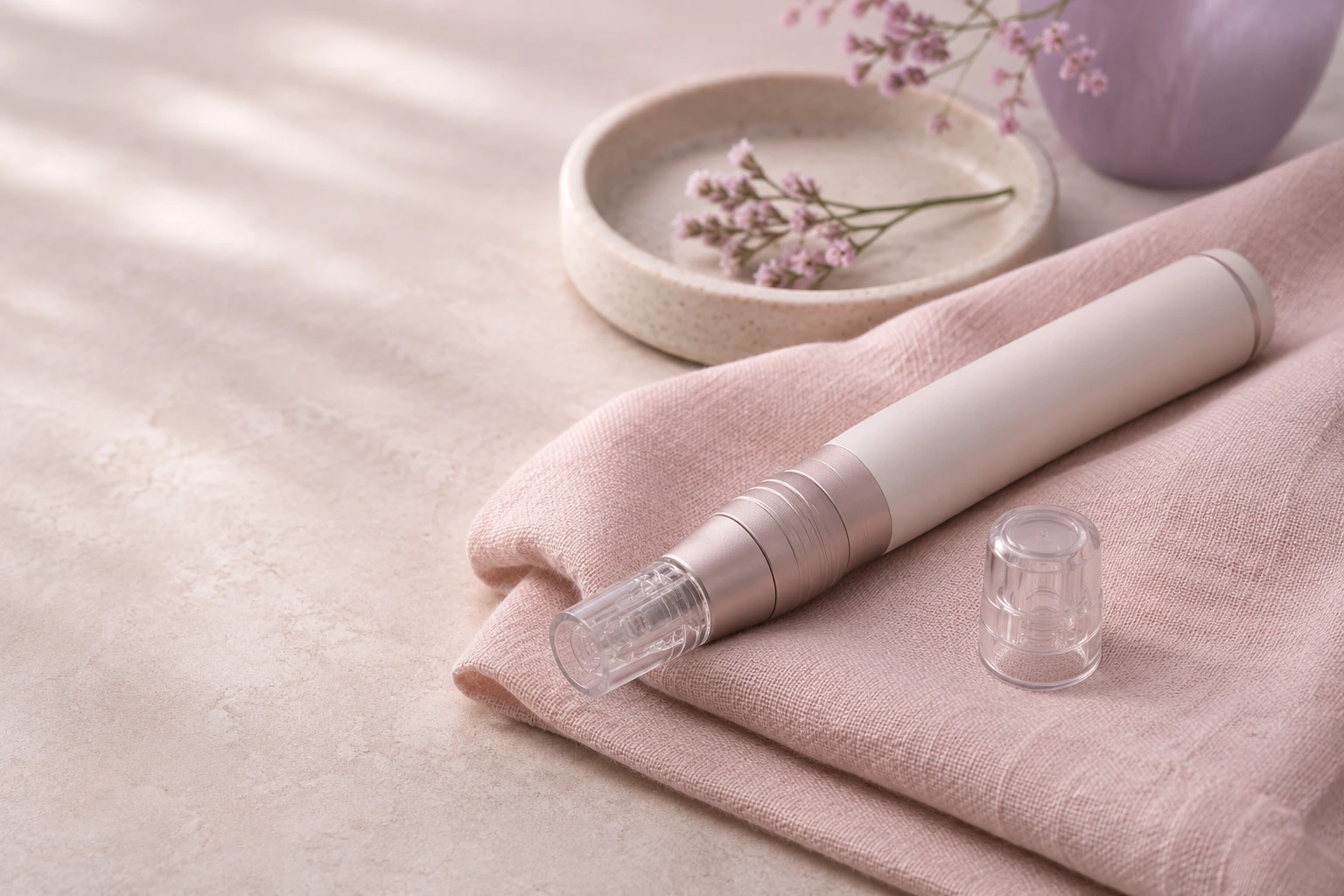
Listen to the key points
Read the short version
Conventional microneedling uses fine needles. RF microneedling adds radiofrequency energy, which can heat tissue. This does not establish that one method is generally better. The direct comparison discussed here applies to the device and study group examined. Both methods carry risks. The FDA has received reports of serious complications with certain RF applications. These reports do not show how often harm occurs or which method is safer. Before treatment, ask about the device, the practitioner's qualifications, possible risks and realistic expectations.
What do microneedling and RF microneedling mean?
Microneedling describes procedures in which fine needles mechanically penetrate the skin. Depending on the device, the needles may sit on a roller, a stamping surface or a motorised handpiece. The shared name describes how the procedure acts on the skin. It does not identify one standard device or an identical procedure. [1]
RF stands for radiofrequency. In RF microneedling, special needles also act as small electrodes: alongside their mechanical action, they deliver electrical energy that produces local heating. When comparing two offers, first establish whether they mean mechanical needling alone or an application with additional RF energy. [2]
Adding energy is a technical distinction. The name does not establish a general ranking in which RF is better for every skin concern. The exact device, the purpose studied and the relevant results provide more useful information. [1][2][3]
Mary4Beauty describes its conventional microneedling offer on the microneedling treatment page. That service description is separate from this editorial RF comparison.
How do their principles differ?
In conventional microneedling, needles create small mechanical injuries in the skin. The illustration shows this shared starting point of both procedures. It does not prescribe a needle depth or depict an anatomically exact treatment. [1]
The RF version adds a second influence: energy reaches the tissue through the electrodes. Where and how heating occurs depends on the device and its application. The separate RF symbols in the illustration mark this additional energy; they are not a measured temperature map. [2]
Comparing the two methods
Simplified illustrationMechanical needle action
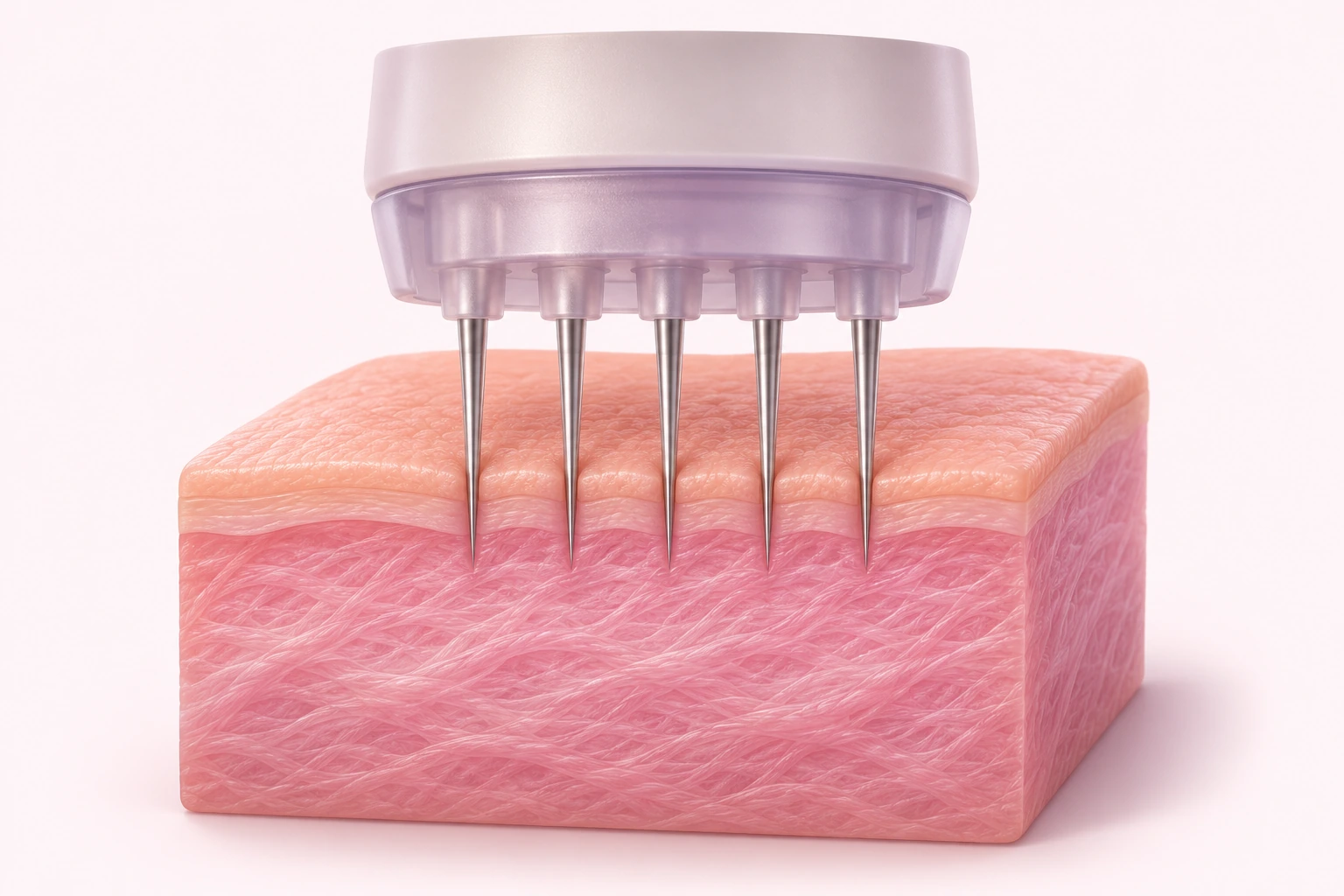
Fine needles create small mechanical injuries in the skin. This method does not involve additional RF energy.[1]
Needles + RF energy
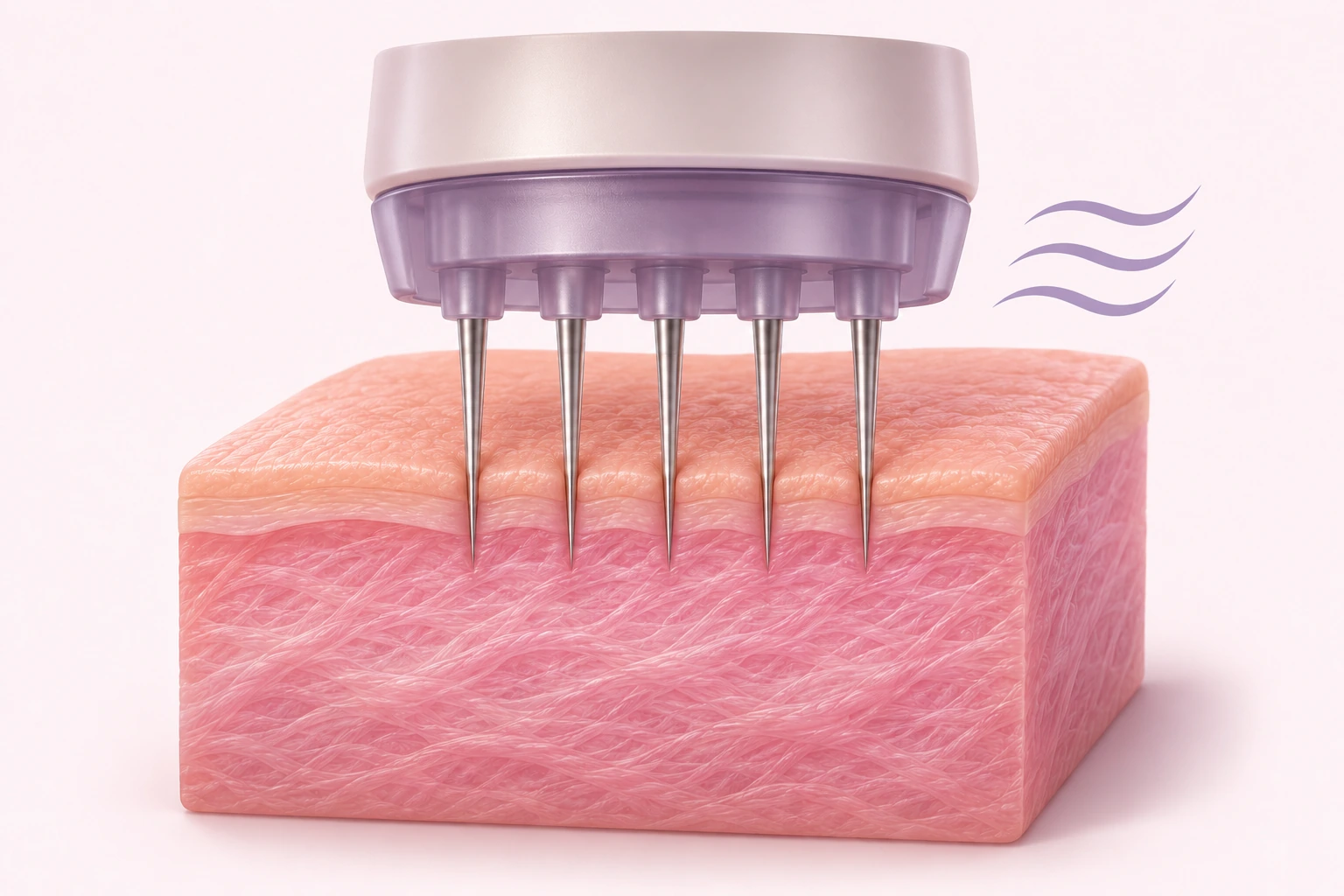
Radiofrequency energy is also delivered. The heating and its distribution depend on the device and how it is used.[2]
Which differences matter in a comparison?
A useful comparison examines the same properties for both procedures. The table connects technical differences with information you still need about a particular offer. It does not assess an individual person or award effectiveness scores.
On a small screen, scroll the table sideways to see all columns.
| Criterion | Conventional microneedling | RF microneedling | Why it matters |
|---|---|---|---|
| Basic action | Fine needles mechanically penetrate the skin. | Mechanical needles plus electrical RF energy. | The additional letters describe a technical difference, not established superiority. |
| Role of heat | Additional RF energy is not part of the basic principle. | RF energy can produce local heating in tissue. | Its nature and distribution depend on the exact application. |
| Device identity | Possible designs include rollers, stamps and motorised systems. | The particular electrode and RF-system configuration belongs in the description. | A method name alone is insufficient to match an offer to a study. |
| Concern studied | The skin area and the task studied need to match. | The same applies to the additional RF application. | Eye-area data do not automatically answer acne-scar questions. |
| Result measurement | Visible assessment and instrument readings must be distinguished. | The exact measurement named also matters here. | Cutometer R2, for example, is not a percentage of visible improvement. |
| Risk information | Possible risks of skin injury, such as bleeding or infection. | Reports of serious RF complications also matter. | The sources used here do not provide a direct percentage-risk comparison. |
| German context | The particular application still needs assessment. | Section6(2) NiSV applies to certain high-frequency applications. | A marketing name cannot establish qualifications or whether an application is permitted. |
Principles and risks: FDA; specific study example: Hwang2025; German regulatory context: Section6 NiSV. This is not a dosage or operating table. [1][2][3][4]
The distinction between a method and a device matters especially. A study of one RF system and configuration does not automatically describe every other RF offer. Equally, a general description of microneedling does not make all mechanical devices interchangeable. [1][2][3]
The skin concern also belongs in the comparison. An elasticity measurement and an acne-scar study answer different questions. Additional technology alone does not bridge that gap. [3]
Which skin question needs an answer?
“Better-looking skin” can mean different things: a change in scar texture, finer lines or a different appearance of the skin surface. Naming the desired change more precisely helps you check whether the cited research measured anything corresponding to it. [1][3]
Wrinkles and instrument measurements
The direct comparison described below studied the eye area of older women. Alongside assessments of wrinkles, instruments measured skin properties such as elasticity. These values add to observation; they are not a universal measure of a visibly younger face. [3]
Acne scars are a separate question
The Hwang study examined ageing skin around the eyes, rather than depressed acne scars. It cannot therefore decide which procedure would be more suitable for a particular scar type. That would require evidence addressing the scar question and an individual professional assessment. [3]
What does a direct comparison show?
In 2025, Hwang and colleagues compared the two sides of the same participants’ faces. They used the same system, Sylfirm X, with RF energy switched on or off. This design helps examine the additional RF application within that particular study. It is not a comparison of all conventional mechanical devices with all RF devices. [3]
The participants were Korean women aged 60–71; the eye area was studied. Thirty women started the trial and 29 completed it. These details show which people and body area the example concerns. Applying it to another age group, device or scar procedure would need a separate justification. [3]
These results concern one particular application. Relating them to an offer requires comparing its conditions with the study conditions. A general reference to “RF studies” is not enough.
What does a value in the chart mean?
The following chart shows one instrument-based elasticity value from this study: Cutometer R2. It is a measurement index, rather than a percentage of visible improvement or a measure of personal satisfaction. The two series refer to RF off and RF on in the same studied system. [3]
An instrumental elasticity measure over study time
Cutometer R2 (instrument index) · R2 · Baseline / Month 3 / Month 5 · Korean women aged 60–71; periocular skin; 30 enrolled, 29 completed; cell n not stated
Cutometer R2 (instrument index) (R2)
Baseline
- MN (RF off): 0.60 R2
- MNRF (RF on): 0.56 R2
Month 3
- MN (RF off): 0.58 R2
- MNRF (RF on): 0.60 R2
Month 5
- MN (RF off): 0.61 R2
- MNRF (RF on): 0.62 R2
Data table
| Device / context | Timepoint | Value | n | Uncertainty | Source |
|---|---|---|---|---|---|
| MN (RF off) · Sylfirm X (Viol) | Baseline | 0.60 R2 | Not reported | Mean ± SD (SD = 0.08); bounds 0.52–0.68 R2 | Hwang et al. (2025), Table 2 |
| MNRF (RF on) · Sylfirm X (Viol) | Baseline | 0.56 R2 | Not reported | Mean ± SD (SD = 0.07); bounds 0.49–0.63 R2 | Hwang et al. (2025), Table 2 |
| MN (RF off) · Sylfirm X (Viol) | Month 3 | 0.58 R2 | Not reported | Mean ± SD (SD = 0.07); bounds 0.51–0.65 R2 | Hwang et al. (2025), Table 2 |
| MNRF (RF on) · Sylfirm X (Viol) | Month 3 | 0.60 R2 | Not reported | Mean ± SD (SD = 0.07); bounds 0.53–0.67 R2 | Hwang et al. (2025), Table 2 |
| MN (RF off) · Sylfirm X (Viol) | Month 5 | 0.61 R2 | Not reported | Mean ± SD (SD = 0.08); bounds 0.53–0.69 R2 | Hwang et al. (2025), Table 2 |
| MNRF (RF on) · Sylfirm X (Viol) | Month 5 | 0.62 R2 | Not reported | Mean ± SD (SD = 0.07); bounds 0.55–0.69 R2 | Hwang et al. (2025), Table 2 |
Comparison of the effects of fractional microneedle radiofrequency and microneedling on modulating the senescent fibroblast milieu in aged skin
DOI: 10.1038/s41598-025-02545-3
Back to data row:
MN (RF off) · BaselineThe bars start at zero and show the published means. The marked spread is a standard deviation (SD), not a confidence interval. The data table also lets you read each number pair without the graphic. [3]
Interpretation also depends on what was compared statistically. The tests reported in Table 2 concern changes from each facial side’s own baseline. Placing the bars side by side does not, by itself, demonstrate a clinical advantage for an entire class of procedures. [3]
What can be said about results and duration?
A result at a particular time first answers what was observed by that point. Month 5 of the study was eight weeks after the last treatment. This does not establish a promise that a change will last permanently. [3]
A measurable difference and a visible change that matters to you are also different things. The desired change and how it will be assessed therefore belong in the discussion before treatment. The data shown here do not provide an individual prediction. [1][3]
The term microneedling or RF alone cannot provide a universal recovery plan, treatment count or result duration. A particular offer should explain expectations and limits for the intended application, rather than simply naming a device class. [1][2]
Which risks belong in the comparison?
Needles injure the skin, so safety already belongs to the basic principle. The FDA lists redness, bleeding, bruising and infection among possible microneedling risks; pigmentation changes can also occur. The relevant personal circumstances and risks must be discussed before an application. [1]
On 15 October 2025, the FDA issued a safety communication about certain uses of RF microneedling. It reports serious complications including burns, scarring, fat loss and nerve damage. This information belongs visibly in a comparison involving additional RF energy. [2]
How does the German context fit?
The FDA is a US authority. Its information helps explain technology and safety, but it is not German authorisation or a decision about a particular offer in Germany. [1][2]
Section 6 of the German NiSV is relevant to high-frequency applications. Paragraph 2 reserves applications that injure the integrity of the epidermis as a protective barrier to physicians, alongside other listed applications. It specifies licensed physicians with the appropriate medical further or continuing training. [4]
The exact technology and application therefore matter when assessing an offer. This page’s comparison does not replace a check of a particular device or an assessment of whether, and by whom, its application may be carried out. [4]

Which questions help before an appointment?
These questions turn a general method name into a concrete description that can be checked. They do not replace professional advice, but help keep the discussion about the same things.
Which exact method and device are meant?
Establish whether additional RF energy is used and which system is intended. This makes it clearer what descriptions of the procedure and study references actually concern. [1][2]
Which study addresses my concern?
Ask about the skin question, body area and people studied. Data from the eye area of older women, for example, do not automatically answer an acne-scar question. [3]
Which risks and requirements are discussed beforehand?
The explanation should include possible complications, hygiene, qualifications and individual circumstances. A method name alone does not answer these questions. [1][2][4]
How will a meaningful result be assessed?
A visible change, an instrument reading and a follow-up period should be identified separately. This supports a concrete discussion of expectations without promising a permanent result. [1][3]
Further questions about microneedling and RF
Is RF microneedling a device for home use?
The FDA explicitly describes RF microneedling as a medical procedure and warns against using these devices at home. This is US safety information, rather than German device authorisation. [2]
Does it automatically include delivering a serum into the skin?
Needling and combining it with a product are separate questions. The FDA notes that, within its authorisation context, microneedling devices are not authorised to deliver cosmetics, medicines or blood products into the skin. This should not be read as a blanket German legal statement; a combination needs its own assessment. [1]
Can I take my treatment count from the study?
A studied schedule first describes the study itself. It is not a personal treatment plan. The bar chart cannot decide which application is suitable for an individual or which expectations can reasonably be attached to it. [1][3]
A useful comparison goes beyond the RF label: how does the specific system work, which skin concern was studied and how is a result assessed? The study shown here helps keep these questions separate, but does not provide a personal prediction. If you are considering cosmetic care, you can discuss your wishes and remaining questions during a first visit to Mary4Beauty. Our own microneedling offer remains separate from this editorial comparison with RF.
Further reading
LED and photobiomodulation
A separate explanation of light-based methods, helping distinguish different technologies.
Microneedling myths fact-checked
A complementary blog article about common beliefs and the distinction between professional application and home needling.
At Mary4Beauty
Microneedling at Mary4Beauty
Information about our cosmetic services: the following pages describe our conventional microneedling treatment and introductory treatment.
Microneedling
What does conventional microneedling at the studio involve? Our treatment page explains the service and procedure.
View treatmentYour first visit
What does the introductory treatment include? Read about the service for your first visit.
Explore your first visitThis section links to our own cosmetic services. The editorial comparison of methods is not an individual treatment recommendation. This article does not imply that Mary4Beauty offers RF microneedling.
Sources & studies
US Food and Drug Administration (2025)
Official US patient information on principles and risks; not German authorisation.
US Food and Drug Administration (2025)
Potential Risks with Certain Uses of Radiofrequency (RF) Microneedling.
Safety communication dated15October2025 concerning certain RF uses; not an incidence study or direct risk comparison.
Hwang et al. (2025)
Device-specific split-face comparison in the eye area of older Korean women. Chart values: Table2. The authors disclose device and research support from Viol.
Gesetze im Internet
§6 NiSV — Fachkunde zur Anwendung von Hochfrequenzgeräten.
Current German section concerning high-frequency applications; not an assessment of an individual device or provider.