Understanding dry and dehydrated skin
Skin feels tight after washing, a cream feels comfortable, and product labels mention “dry”, “dehydrated” or “moisture-depleted” skin. Those words can sound like two clearly separate causes. The medical description of dry skin is broader: both skin lipids and water-binding substances can be involved. Concrete observations therefore make a better starting point for discussing care than a quick skin-type test that claims to identify the cause from one sign. [1][2]
Understand the terms
Listen to the key points
0:33
Read the short version
The labels dry and dehydrated do not, by themselves, identify two separate causes. Dryness can involve both skin lipids and substances that bind water. It also helps to distinguish water held in the skin from water lost to the outside. Tightness or flaking alone does not explain the cause. In a skincare discussion, describe when and where changes started and which products you use. If a measurement is offered, ask what it actually assesses. Persistent symptoms, substantial itching, pain or inflamed areas need medical assessment.
If playback does not work, you can read the short version or open the audio file.
Open audio fileDry or dehydrated: what do the words mean?
“Dry” initially describes a skin condition. In dermatology, the term xerosis cutis is also used. The German Dermatological Society’s position paper describes a deficiency in lipids and/or water-binding substances. Lipids are fats; the water-binding substances include the natural moisturising factors of the outer skin layer. Dry skin therefore does not automatically mean a lack of oil alone. [1][2]
“Dehydrated” or “moisture-depleted” directs attention to water in the skin during everyday skincare discussions. That can be a useful description. But the simple rule “dry skin only needs oil, dehydrated skin only needs water” does not explain which processes are actually involved. The medical definition used here does not establish that sharp division. [2]
The claim that one is always an unchanging skin type while the other is always temporary should not replace individual assessment either. Dry skin can relate to predisposition, the environment, diseases or medicines. It therefore helps to ask what a term means in a particular conversation: a sensation, a visible finding, a measurement, or a cause assessed by a doctor. [1]
Holding water and losing water are different processes
The outermost skin layer, the stratum corneum, helps retain water. Natural moisturising factors, often shortened to NMF, bind water within the corneocytes, the cells of that layer. Lipids lie between those cells, and their composition also matters for the barrier. Water binding inside cells and the lipids between them are different parts of the same water-retention context. [1][2]
At the same time, skin continually loses water to the outside. Transepidermal water loss, or TEWL, describes that outward flow through the skin surface, expressed per area and time. Water content answers a different question: how much water is present. A flow and an amount of water are different properties. [3]
Distinguishing skin water content from water loss
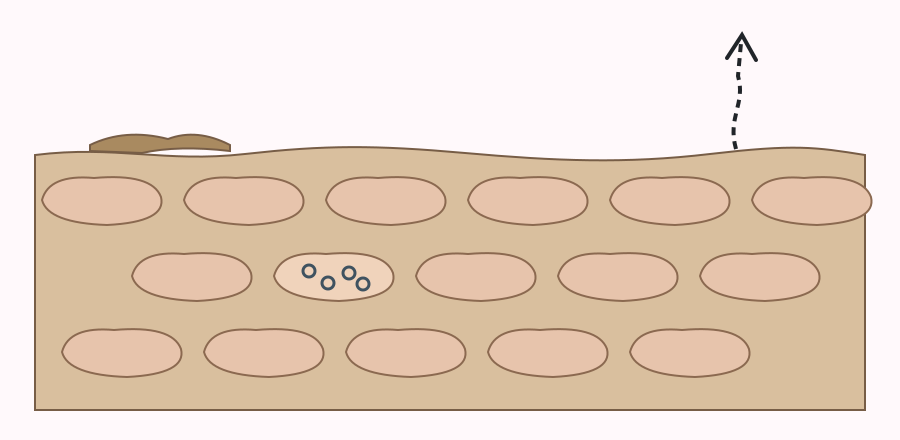
Water binding inside the outer skin cells
Natural moisturising factors help bind water within the corneocytes. [1]
Lipids between the cells
The composition of fats between the outer skin cells helps limit evaporation. [1]
Outward water loss
TEWL describes water flow through the skin surface, not a water reservoir level. [3]
Sebum is another term. Sebaceous glands release it onto the surface, where it supports barrier function. It is not the same as the lipids between the outer skin cells. A surface-sebum reading therefore cannot simply be read as a measurement of all skin lipids. [1][2]
This distinction is useful when interpreting care: “more hydration”, “less water loss” and “more sebum” are not interchangeable statements. A study or service description should explain which one it actually means.
The skin barrier article explains in more detail how these components work together.
What sensations and measurements can tell you
Tightness, roughness and flaking are concrete observations. They deserve to be described rather than hidden behind a general label such as “dehydrated”. On their own, however, they do not reliably identify why a change occurred. External influences, predisposition, diseases and medicines can all be relevant. Even visible changes therefore need context. [1]
A skin-measuring device answers a different, limited question. Hydration, water loss and surface sebum are assessed by different methods. The table helps clarify what an observation or measurement means. [2][3]
On a small screen, scroll the table sideways to see all columns.
| Observation or measurement | What information it concerns | What it does not establish alone | Useful question |
|---|---|---|---|
| Tightness or flaking | A perceived or visible change. [1] | The specific cause or measured water content. | When, where and in what circumstances does it occur? |
| Hydration measurement / corneometry | Instrument-based assessment of hydration in the outer skin layer. [2] | A TEWL value, sebum quantity or the complete cause. | What does this device assess, and under which conditions? |
| TEWL measurement | Water loss per area and time: an outward flow. [3] | A water reservoir level or an overall skin-health percentage. | Are device, temperature, humidity and air movement accounted for? |
| Sebum measurement | Information about sebum at the surface. [1][2] | The quantity or composition of all intercellular lipids, or sufficient hydration. | Does the value concern surface sebum or another property? |
The limits in the third column distinguish different properties. They are not a diagnostic algorithm or a scoring scale. [1][2][3]
With TEWL in particular, the device and surrounding conditions influence the measurement. Temperature, humidity and air movement are therefore relevant details. One number without that context is not a complete explanation of skin condition. Doctors usually assess dry skin clinically; specialised measuring devices are not a basic requirement for that diagnosis. [2][3]
If a provider gives a percentage, a straightforward question is: “A percentage of what, and what does it mean for my care?” A clear explanation is more useful than a broad judgement such as “your skin is not healthy enough”.
Why everyday conditions can change skin condition
A general care discussion should also consider cleansing and the environment. Frequent, prolonged hot washing, alkaline cleansers or dry heated indoor air are among the possible stresses on skin. Gentle cleansing and protection from drying influences are therefore useful topics. They do not, however, produce one fixed routine that is suitable and tolerable for everyone. [1]
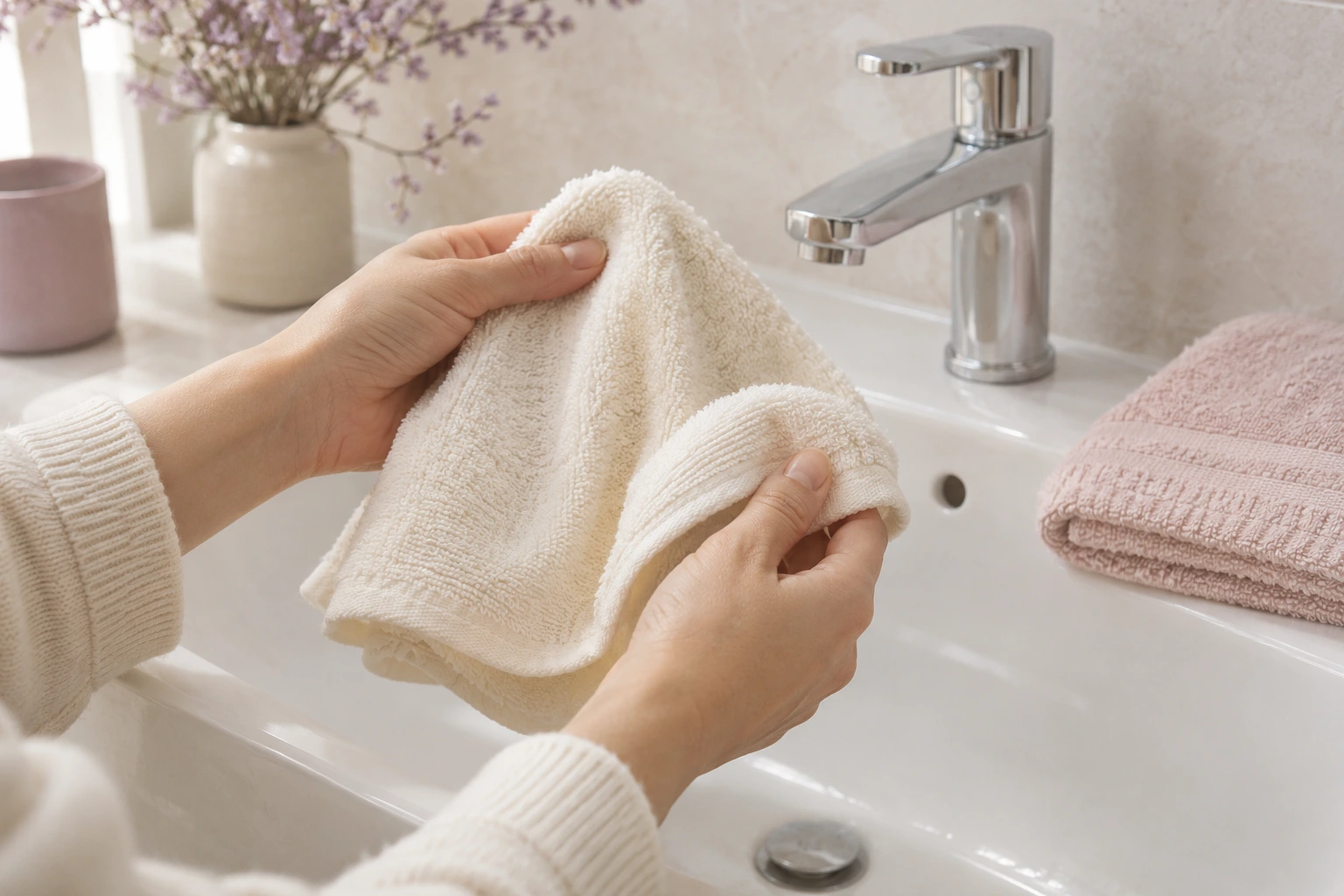
Water touching the skin does not mean the outer layer retains it well. Frequent contact with water or irritating substances can put stress on skin; the official health portal gives swimming and activities involving frequent wet contact as examples. Cleansing and binding water within the outer skin layer are therefore different processes. Water retention also involves the skin’s own natural moisturising factors and the lipids of that layer. [1]
Cold, wind and low humidity can also dry the skin. Together with a change in cleansing, several external factors may therefore be involved. Dryness noticed in winter does not, however, prove that heated indoor air is the only cause. Predisposition, diseases or medicines may also be relevant. [1]
For a skincare discussion, this distinction is more useful than a new skin-type label: what comes into contact with the skin, and under which conditions does the change become noticeable? Everyday exposure can then be considered alongside skincare. These observations alone cannot establish the individual cause or the measures needed. [1]
Understanding care without self-diagnosis
Skincare labels often describe different functions. Moisturising can refer to ingredients that bind water in the outer skin layer. Lipid-replenishing concerns the lipid components. Film-forming describes a protective layer on the surface. A formulation can combine these functions; this is not a contest in which only one is always appropriate. [1]
Glycerol, for example, is a water-binding ingredient. Ceramides are lipids relevant to the stratum corneum. The name of one ingredient does not describe a finished product completely, however. Its base and combination of ingredients also influence its properties. One ingredient name therefore cannot establish either a product ranking or a promised result for your skin. [1][2]
An Introductory Facial provides a cosmetic setting to discuss your current care, wishes and possible intolerances. It does not establish or rule out a medical cause.
Questions for a skincare discussion
You do not need to assign yourself a skin type or complete a scoring system before a discussion. Specific information makes it easier to explain what is troubling you. These questions organise observations and expectations; they are not a self-diagnosis test. [1][2]
When and where did you notice the change?
Try to describe whether tightness, roughness, flaking or other symptoms stand out. Timing and the affected areas matter for assessment; the single word “dry” often describes the situation too broadly. [1]
What changed after cleansing, skincare or a change of surroundings?
A new routine, more frequent washing or a different environment can inform the discussion. A close timing relationship does not itself prove the cause. [1]
Which products do I tolerate, and what have I started recently?
Bring the products or their names. This allows a discussion of your actual routine and previous intolerances rather than advertising terms alone.
What does an offered skin measurement assess?
Ask about the property, device and conditions. What matters is how the value is explained and the limited conclusion it allows, not simply whether a number looks high or low. [2][3]
What can be discussed cosmetically, and when is a doctor needed?
Care questions can be discussed at the studio. Persistent or marked symptoms need medical assessment of their possible cause. A cosmetic assessment does not replace that examination. [1]
When medical assessment matters more
Common questions
Will drinking more water automatically help?
The cosmetic label “moisture-depleted skin” does not imply a particular drinking amount. An older systematic review found indications of a slight increase in skin hydration after additional water intake in healthy adults, particularly among those with lower previous intake. However, the amount and methodological quality of the research were weak; relationships with TEWL and sebum remained unclear. Only the publisher’s abstract was assessed here. It cannot establish a universal solution for clinically dry skin. [4]
Does soft-feeling skin prove the barrier is intact again?
A pleasant feel matters when using skincare. It initially describes your perception, however. Whether a particular barrier property has changed is a different question. Sensation, water content and water loss should therefore remain distinct even after a positive experience. A feeling alone does not demonstrate a particular measured barrier effect. [1][2][3]
What this understanding helps you do
“Dry” and “dehydrated” can start a conversation, but they are not complete explanations. A description becomes more informative when sensation, water binding, water loss and external influences are kept distinct. This also helps clarify a skincare offer: what function is the formulation intended to serve, and what supports that assessment? A single ingredient or measurement cannot answer those questions completely. Concrete observations and your existing products connect the discussion to everyday life. Persistent or marked symptoms need medical assessment of the possible cause; cosmetic advice cannot replace that step.
Discuss your own skincare calmly
Introductory Facial at Mary4Beauty
At your first visit, we discuss your wishes, current care and possible intolerances. The Introductory Facial includes a conversation, cosmetic skin assessment and the care chosen together. This does not replace medical assessment.
Explore the Introductory FacialSources & studies
gesund.bund.de / Bundesministerium für Gesundheit (2025)
Official health portal, checked by the DDG; updated 17 September 2025. Terms, general care and medical-assessment boundaries. Not a treatment trial.
Back to textAugustin et al. (2019)
Diagnosis and treatment of xerosis cutis – a position paper
Older DDG position paper combining literature and expert consensus on xerosis definition and assessment. Beiersdorf support and further conflicts of interest disclosed. A position paper, not a new randomised trial.
Back to textKlotz et al. (2022)
Devices measuring transepidermal water loss: A systematic review of measurement properties
Systematic review of TEWL device reliability and measurement error; definitions and limitations from selected sections used here. Not a treatment trial.
Back to textAkdeniz et al. (2018)
Does dietary fluid intake affect skin hydration in healthy humans? A systematic literature review
Systematic review in healthy adults; only the publisher abstract assessed here. Limited, methodologically weak evidence, not a general xerosis treatment recommendation.
Back to text